


Srimad Bhagavatam and Vedanta Sutras: How They Perfectly Complement Each Other
Imagine being handed the most profound philosophical book ever written—one that claims to explain the nature of God, the soul, consciousness, reality, and the purpose of existence. Then imagine opening it and finding that many of its teachings are compressed into short, highly condensed statements, often just a few words long.
That is the experience many students encounter when approaching the Vedanta Sutras.
The sutras are brilliant. They are precise. They are intellectually powerful.
They are also extremely concise.
This raises an important question:
How can such brief aphorisms fully explain subjects as vast as the Absolute Truth, creation, liberation, karma, and devotion?
The answer, according to the Vedic tradition, is found in the ISKCON Mayapur Store and especially within the Srimad Bhagavatam.
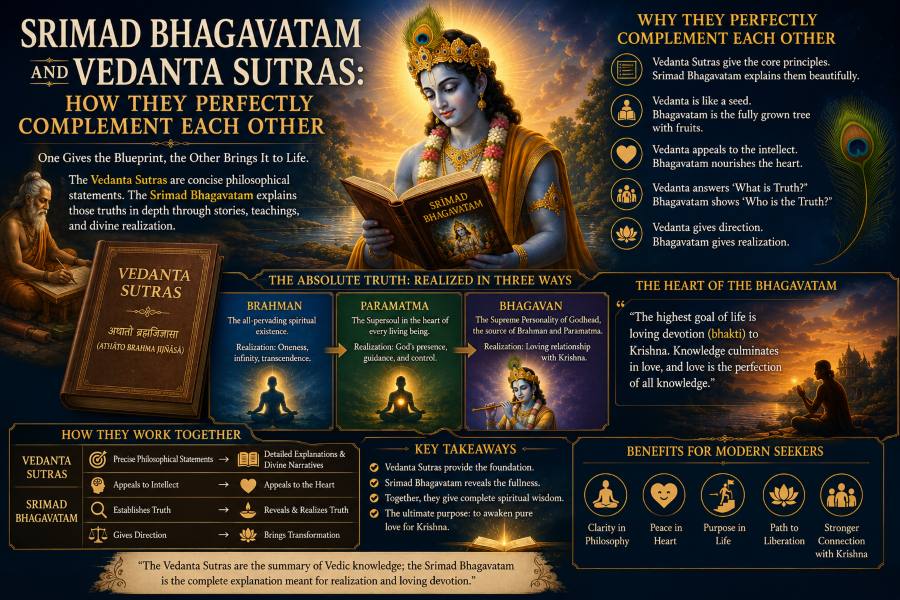
The Srimad Bhagavatam is often described as the natural commentary on the Vedanta Sutras. If the Vedanta Sutras provide the philosophical blueprint, the Bhagavatam provides the complete architectural masterpiece.
One supplies the framework.
The other fills that framework with life, personality, stories, examples, and spiritual realization.
Understanding how these two works complement each other opens an entirely new dimension of Vedic wisdom.
Why the Vedanta Sutras Were Written in the First Place
Before exploring their relationship, it helps to understand the purpose of the Vedanta Sutras.
The Vedas contain an enormous amount of knowledge.
They discuss:
- Spiritual realization
- Rituals
- Ethics
- Cosmology
- Meditation
- Devotion
- Liberation
- The nature of God
Because the Vedic literature is so extensive, sages sought a way to summarize its essential conclusions.
This led to the composition of the Vedanta Sutras by Veda Vyasa.
The word “sutra” literally means a thread.
Just as a thread connects beads into a necklace, each sutra connects profound philosophical concepts into a coherent system.
The Vedanta Sutras therefore function as a concise summary of Vedic philosophy.
Their goal is simple:
To establish the ultimate nature of reality and guide sincere seekers toward spiritual understanding.
Brilliant but Brief: The Challenge of the Sutras
The Vedanta Sutras are famous for their brevity.
A single sutra may contain only a few words.
Yet entire philosophical schools have written extensive commentaries attempting to explain those words.
This brevity creates both strength and difficulty.
The strength lies in precision.
Nothing unnecessary is included.
The difficulty lies in interpretation.
Without explanation, many sutras remain difficult for ordinary readers to grasp fully.
Imagine receiving the outline of a great novel without the chapters.
The outline contains the essential structure.
The emotional depth, character development, and complete narrative still need to be revealed.
This is where the Srimad Bhagavatam enters the discussion.
The Bhagavatam’s Extraordinary Claim
Among all Vedic texts, the Srimad Bhagavatam occupies a unique position.
Traditional Vaishnava teachers describe it as the mature fruit of the Vedic tree.
More significantly, they identify it as Vyasa’s own expanded explanation of the Vedanta Sutras.
This claim carries enormous importance.
Why?
Because it suggests that the author himself provided the commentary.
Instead of relying solely on later interpretations, readers can study the text traditionally understood to reveal the intended meaning behind the sutras.
The Bhagavatam does not merely discuss Vedantic ideas.
It unfolds them in rich detail.
Concepts that appear briefly in the sutras become living realities within its pages.
A Story Behind the Scriptures
One of the most fascinating aspects of this relationship involves Vyasa himself.
According to traditional accounts, Vyasa completed monumental literary achievements.
He organized the Vedas.
He composed the Vedanta Sutras.
He compiled numerous sacred texts.
Yet despite these accomplishments, he felt dissatisfied.
Something remained incomplete.
At this point, the sage Narada Muni appeared and offered insight.
Narada explained that although Vyasa had described many aspects of spiritual life, he had not fully and directly glorified the Supreme Personality of Godhead and pure devotional service.
Inspired by this instruction, Vyasa entered deep meditation and composed the Srimad Bhagavatam.
This narrative is significant because it presents the Bhagavatam not as a separate work, but as the culmination of Vyasa’s entire literary mission.
The Same Truth Through Two Different Approaches
One useful way to understand the relationship is through comparison.
The Vedanta Sutras present truth analytically.
The Bhagavatam presents truth experientially.
The Vedanta Sutras often ask:
- What is Brahman?
- What is the source of creation?
- What is the nature of reality?
- What is liberation?
The Bhagavatam answers these questions while showing how they affect real lives, real relationships, and real spiritual practice.
The two texts therefore address different dimensions of learning.
One appeals strongly to philosophical reasoning.
The other engages both intellect and heart.
Together they create a complete educational experience.
Janmady Asya Yatah: One Sutra, an Entire Scripture
Perhaps the clearest example appears at the very beginning.
The famous Vedanta Sutra opens with:
Janmady asya yatah
This statement identifies the Absolute Truth as the source of everything.
Simple words.
Immense implications.
Who is this source?
What are His qualities?
How does creation occur?
What is His relationship with living beings?
The Srimad Bhagavatam begins by expanding this very principle.
Its opening verses explore the nature of the Absolute Truth in extraordinary depth.
What appears as a concise philosophical declaration within the sutra becomes a fully developed theological vision within the Bhagavatam.
This pattern repeats throughout the text.
The Bhagavatam continually expands ideas that appear in condensed form within Vedanta.
Philosophy Becomes Personal
One of the most remarkable contributions of the Bhagavatam is its presentation of the Absolute Truth as personal.
Many readers approach Vedanta expecting abstract metaphysical discussions.
The Bhagavatam certainly includes philosophy.
Yet it goes further.
It reveals the Absolute Truth as Krishna, the Supreme Person.
This shift changes everything.
Reality is no longer understood merely as an impersonal principle.
It becomes relational.
The soul’s connection with the Divine becomes central.
Love becomes central.
Devotion becomes central.
Knowledge remains important, but knowledge now serves relationship rather than existing as an end in itself.
This perspective explains why the Bhagavatam places such strong emphasis on bhakti.
Why Stories Matter in Spiritual Education
Some people mistakenly assume that stories are less important than philosophy.
The Bhagavatam demonstrates the opposite.
Stories often communicate truths more effectively than abstract concepts.
Consider how difficult it would be to explain devotion purely through definitions.
Now consider the lives of:
- Prahlada Maharaja
- Dhruva Maharaja
- Ambarisha Maharaja
- Queen Kunti
- The residents of Vrindavan
These personalities embody philosophical principles.
Readers do not merely study devotion.
They witness it.
They observe how spiritual knowledge functions under real circumstances.
The Bhagavatam therefore transforms philosophical ideas into lived experience.
That transformation is one reason it remains so influential.
The Heart of Vedanta Revealed
At its core, Vedanta seeks to answer life’s greatest questions:
Who am I?
Who is God?
Why do I suffer?
What is the purpose of existence?
How can liberation be attained?
The Bhagavatam answers these questions repeatedly from different angles.
Its conclusion is consistent.
The soul is eternal.
Krishna is the Supreme Reality.
Material existence is temporary.
Pure devotion is the highest path.
Love of God is the ultimate goal.
In this sense, the Bhagavatam does not replace the Vedanta Sutras.
It illuminates them.
It reveals their deepest intention.
It shows not only what truth is but how that truth transforms human life.
Why the Great Acharyas Saw the Bhagavatam as the Natural Commentary on Vedanta
Throughout history, many respected Vedic teachers emphasized the intimate connection between the Srimad Bhagavatam and the Vedanta Sutras.
This was not merely a literary observation.
It was a philosophical conclusion.
The Vedanta Sutras establish principles.
The Bhagavatam explains those principles in a way that can be understood, practiced, and realized.
Imagine studying advanced mathematics using only formulas.
The formulas contain truth, but understanding grows when examples and explanations are added.
The Bhagavatam performs a similar role.
It takes profound metaphysical concepts and demonstrates how they operate within reality.
For this reason, generations of Vaishnava acharyas repeatedly pointed students toward the Bhagavatam when seeking the deeper meaning of Vedanta.
They understood that philosophy reaches its fullest expression when it transforms consciousness.
Brahman, Paramatma, and Bhagavan: Three Levels of Realization
One of the Bhagavatam’s most famous contributions is its explanation of the Absolute Truth.
Many spiritual traditions discuss ultimate reality.
The Bhagavatam presents a uniquely detailed framework.
It explains that the Absolute Truth is realized in three progressive aspects:
Brahman
Brahman refers to the all-pervading spiritual reality.
It represents the infinite spiritual existence underlying everything.
Those who realize Brahman perceive transcendence beyond material limitations.
This realization brings freedom from many misconceptions.
Yet the Bhagavatam describes it as the beginning rather than the end of spiritual understanding.
Paramatma
Paramatma refers to the Supersoul residing within the heart of every living being.
At this stage, realization becomes more personal.
The seeker understands that the Divine actively accompanies all souls.
God is not merely an abstract force.
He is present and aware.
Bhagavan
Bhagavan represents the complete personal realization of the Supreme.
According to the Bhagavatam, this realization reveals Krishna as the source of both Brahman and Paramatma.
The seeker no longer understands God merely as energy or presence.
The seeker enters a loving relationship with the Supreme Person.
This progression is one of the Bhagavatam’s most significant contributions to Vedantic thought.
Why Bhakti Appears Again and Again
Readers often notice that the Bhagavatam consistently returns to one theme:
Bhakti.
This repetition is intentional.
The Bhagavatam teaches that devotion is not one path among many equally complete destinations.
Rather, devotion represents the fulfillment of spiritual knowledge.
Knowledge answers questions.
Love creates connection.
A person may understand many facts about another individual.
That understanding remains incomplete without relationship.
Similarly, Vedantic knowledge reaches fulfillment when it develops into loving devotion toward Krishna.
This idea helps explain why the Bhagavatam gives so much attention to devotion.
Bhakti is not presented as an emotional alternative to philosophy.
It is presented as philosophy brought to life.
When Knowledge Alone Reaches Its Limits
The Bhagavatam repeatedly highlights a subtle challenge.
Knowledge can remove ignorance.
Knowledge can reveal truth.
Knowledge alone does not always satisfy the heart.
Human beings are not merely thinkers.
They are also lovers.
They seek connection.
They seek meaning.
They seek relationship.
A purely intellectual understanding of ultimate reality may answer many questions, yet still leave deeper longings untouched.
The Bhagavatam therefore introduces devotion as the natural completion of knowledge.
The goal is not less understanding.
The goal is fuller understanding.
An understanding that includes both wisdom and love.
How the Bhagavatam Resolves Philosophical Tensions
One reason the Bhagavatam remains influential is its ability to harmonize ideas that often appear contradictory.
Consider some common philosophical questions:
Is God Personal or Impersonal?
The Bhagavatam answers both.
The Supreme possesses personal qualities while simultaneously pervading all existence.
Is the Soul One With God or Different?
The Bhagavatam explains a relationship of unity and distinction.
The soul shares spiritual qualities with God while remaining an individual being.
Is Liberation About Knowledge or Devotion?
The Bhagavatam teaches that genuine knowledge naturally culminates in devotion.
The two are complementary rather than competing.
This harmonizing approach gives the text remarkable philosophical depth.
Rather than forcing readers into rigid categories, it reveals how seemingly opposing truths can coexist within a broader spiritual framework.
Why Krishna Occupies the Center of the Bhagavatam
The Vedanta Sutras seek to identify the source of everything.
The Bhagavatam identifies that source as Krishna.
This conclusion is not presented casually.
The entire structure of the text gradually builds toward this understanding.
Krishna is described as:
- The source of creation
- The maintainer of existence
- The ultimate object of love
- The origin of all spiritual and material energies
- The Supreme Reality behind every aspect of existence
As readers progress through the Bhagavatam, philosophical concepts become increasingly personal.
The Absolute Truth acquires a face, a personality, relationships, activities, and qualities.
This personal dimension transforms spiritual inquiry from abstract speculation into meaningful relationship.
Why the Tenth Canto Matters So Much
The first nine cantos of the Bhagavatam establish an enormous philosophical foundation.
They discuss:
- Creation
- Cosmology
- Karma
- Rebirth
- Dharma
- Liberation
- Devotion
- The nature of the soul
Then something remarkable happens.
The Tenth Canto focuses extensively on Krishna’s life and pastimes.
At first glance, some readers wonder why.
The answer becomes clear when viewed through the lens of Vedanta.
The purpose of philosophical inquiry is ultimately to understand the Supreme Truth.
Once that Truth has been established, the Bhagavatam introduces readers to the Supreme Person in intimate detail.
The Tenth Canto therefore represents not a departure from philosophy but its culmination.
Knowledge prepares the way.
Relationship completes the journey.
The Difference Between Understanding and Realizing
A recurring theme throughout both Vedanta and the Bhagavatam is the distinction between intellectual comprehension and realization.
A person may understand that fire burns.
Touching fire creates direct realization.
Similarly, spiritual knowledge becomes transformative when it moves beyond theory.
The Bhagavatam consistently encourages:
- Hearing
- Reflection
- Practice
- Devotion
- Personal transformation
These activities convert philosophical concepts into lived experience.
This practical orientation helps explain why the text continues influencing readers thousands of years after its composition.
Its purpose is not merely education.
Its purpose is realization.
Why These Texts Remain Relevant Today
Some ancient works remain historically interesting but lose practical relevance.
The Bhagavatam and Vedanta Sutras have avoided that fate because they address questions that never disappear.
People still ask:
- Who am I?
- What is consciousness?
- Why do I suffer?
- What happens after death?
- Is there a higher purpose to life?
- Can lasting happiness be found?
Technology changes rapidly.
Human nature changes very little.
The Bhagavatam and Vedanta continue speaking to these timeless concerns.
Their value does not depend upon historical circumstances.
It depends upon the enduring questions that arise within every thoughtful human being.
A Complete Spiritual Education
When studied together, the Vedanta Sutras and the Srimad Bhagavatam provide something extraordinary.
The Vedanta Sutras offer structure.
The Bhagavatam offers substance.
The Vedanta Sutras establish philosophical conclusions.
The Bhagavatam demonstrates those conclusions through narratives, teachings, examples, and spiritual insights.
One sharpens understanding.
The other nourishes realization.
Together they form a complete system of spiritual education.
This is why generations of teachers have encouraged students to approach them as complementary works rather than separate texts.
The relationship is not accidental.
It is intentional.
The Bhagavatam illuminates the heart of Vedanta while Vedanta provides the philosophical foundation upon which the Bhagavatam stands.
For serious seekers, studying both creates a richer, deeper, and more complete understanding of Vedic wisdom.
Why the Bhagavatam Is Called the Ripened Fruit of Vedic Knowledge
The Vedic tradition contains an immense ocean of wisdom.
There are the Vedas, Upanishads, Puranas, Itihasas, and numerous philosophical texts. Each contributes something valuable to the spiritual journey.
Yet the Srimad Bhagavatam is often described as the “ripened fruit” of the Vedic tree.
That description is deeply meaningful.
A fruit represents the final product of a tree’s growth.
Roots, branches, leaves, and flowers all serve a purpose, but the fruit contains the essence.
Similarly, the Bhagavatam presents the mature conclusion of Vedic wisdom.
It does not reject earlier teachings.
It gathers them together and reveals their ultimate purpose.
The Bhagavatam teaches that all genuine spiritual knowledge points toward one destination:
The awakening of loving devotion to Krishna.
This conclusion gives coherence to the entire Vedic tradition.
Knowledge, meditation, ethics, renunciation, worship, and philosophical inquiry all find their highest fulfillment when they deepen one’s relationship with the Supreme.
Why the Bhagavatam Makes Vedanta Easier to Understand
Many sincere readers encounter the Vedanta Sutras and immediately recognize their depth.
They also recognize their difficulty.
The sutras demand concentration, contemplation, and guidance.
The Bhagavatam serves as a bridge.
Instead of presenting ideas only through condensed philosophical statements, it presents them through:
- Conversations
- Narratives
- Historical examples
- Spiritual biographies
- Practical teachings
- Devotional experiences
This approach makes profound truths accessible without diminishing their depth.
A person may struggle to understand a philosophical principle in abstract form.
That same principle often becomes clear when illustrated through a story.
The Bhagavatam excels at this.
It transforms philosophy into something visible, relatable, and memorable.
Read Also:- AC Bhaktivedanta Swami Prabhupada Biography
The Human Heart Needs More Than Logic
One of the Bhagavatam’s greatest strengths is its recognition of human nature.
Human beings are not purely intellectual creatures.
They reason.
They analyze.
They also feel.
They hope.
They love.
They grieve.
They seek connection.
A spiritual system that appeals only to logic often leaves the heart unsatisfied.
A system that relies only on emotion may lack philosophical depth.
The Bhagavatam achieves a rare balance.
It speaks to both dimensions simultaneously.
Readers encounter rigorous philosophical discussions alongside some of the most moving spiritual narratives ever recorded.
This combination helps explain the text’s enduring influence.
From Knowing About God to Knowing God
Many spiritual journeys begin with questions.
Who is God?
What is the Absolute Truth?
Why does suffering exist?
What is the purpose of life?
The Vedanta Sutras help answer these questions.
The Bhagavatam takes readers a step further.
It moves from information about God to relationship with God.
This transition is one of the text’s defining characteristics.
Knowledge remains important.
Yet knowledge becomes a doorway rather than a destination.
The ultimate goal is loving connection with Krishna.
This emphasis transforms spirituality from an intellectual exercise into a living relationship.
Lessons Modern Readers Can Apply Today
The wisdom contained within the Vedanta Sutras and the Bhagavatam remains surprisingly practical.
Their teachings can influence daily life in meaningful ways.
Seek Understanding, Not Just Information
Modern society provides endless information.
Wisdom remains comparatively rare.
The Bhagavatam encourages readers to pursue understanding rather than mere accumulation of facts.
Develop Both Mind and Heart
Intellectual growth matters.
Emotional and spiritual growth matter as well.
A balanced life cultivates all three.
Ask Bigger Questions
Many people become consumed by immediate concerns.
The Bhagavatam encourages reflection upon deeper questions of identity, purpose, and destiny.
Build Relationships on Spiritual Foundations
The text repeatedly demonstrates that relationships become stronger when rooted in values such as compassion, humility, service, and devotion.
Remember the Ultimate Goal
Material achievements have value.
The Bhagavatam reminds readers not to lose sight of spiritual growth while pursuing worldly responsibilities.
Why Bhakti Emerges as the Final Conclusion
One theme consistently rises to the surface throughout the Bhagavatam.
Bhakti is not presented as a secondary practice.
It is presented as the culmination of spiritual realization.
This conclusion emerges naturally from the text’s teachings.
If the soul is eternal and Krishna is the Supreme Reality, then the most complete expression of spiritual life becomes loving service to Him.
Knowledge supports that relationship.
Meditation strengthens that relationship.
Ethical conduct protects that relationship.
Yet devotion remains the center.
The Bhagavatam therefore presents bhakti not as sentimentality but as the highest expression of realized knowledge.
What Happens When Vedanta and Bhagavatam Are Studied Together?
Studying these works together creates a powerful synergy.
The Vedanta Sutras provide philosophical precision.
The Bhagavatam provides spiritual richness.
The Vedanta Sutras answer questions.
The Bhagavatam reveals why those answers matter.
The Vedanta Sutras establish truth.
The Bhagavatam demonstrates how truth transforms life.
Together they offer:
- Intellectual clarity
- Spiritual depth
- Practical guidance
- Philosophical consistency
- Emotional inspiration
- Devotional realization
This integrated approach explains why so many teachers throughout history encouraged serious students to study both texts.
Neither is diminished by the other.
Each enhances the other.
Final Thoughts
The relationship between the Srimad Bhagavatam and the Vedanta Sutras represents one of the most fascinating partnerships in world spiritual literature.
The Vedanta Sutras provide a concise summary of the highest philosophical conclusions of the Vedic tradition.
The Srimad Bhagavatam expands those conclusions into a complete vision of spiritual reality.
One gives the framework.
The other fills that framework with wisdom, stories, devotion, realization, and divine personality.
Together they answer humanity’s deepest questions:
Who am I?
Who is God?
Why do I suffer?
What is the purpose of existence?
How can true fulfillment be found?
The Bhagavatam’s answer is both profound and simple.
The soul is eternal.
Krishna is the Supreme Truth.
Devotion is the highest path.
Love of God is the ultimate perfection of knowledge.
When understood in this light, the Bhagavatam and Vedanta Sutras are not separate streams of wisdom.
They are two expressions of the same spiritual truth, guiding sincere seekers toward understanding, realization, and divine love.
Frequently Asked Questions (FAQ)
What is the relationship between the Srimad Bhagavatam and the Vedanta Sutras?
The Srimad Bhagavatam is traditionally regarded as the natural commentary on the Vedanta Sutras. It expands and explains the philosophical principles presented in concise form within the sutras.
Who wrote the Vedanta Sutras?
The Vedanta Sutras were compiled by Veda Vyasa, who is also credited with compiling the Srimad Bhagavatam and organizing much of the Vedic literature.
Why are the Vedanta Sutras difficult to understand?
The sutras are intentionally brief and highly condensed. Their concise style requires commentary and explanation to reveal their full meaning.
Why is the Srimad Bhagavatam important for understanding Vedanta?
The Bhagavatam explains Vedantic concepts through narratives, examples, theology, and devotional teachings, making profound philosophical truths more accessible.
What is the highest conclusion of the Bhagavatam?
The Bhagavatam teaches that pure devotional service (bhakti) to Krishna represents the highest expression of spiritual realization.
Does the Bhagavatam support both philosophy and devotion?
Yes. The Bhagavatam combines rigorous philosophical inquiry with deep devotional teachings, creating a balanced and comprehensive spiritual system.