

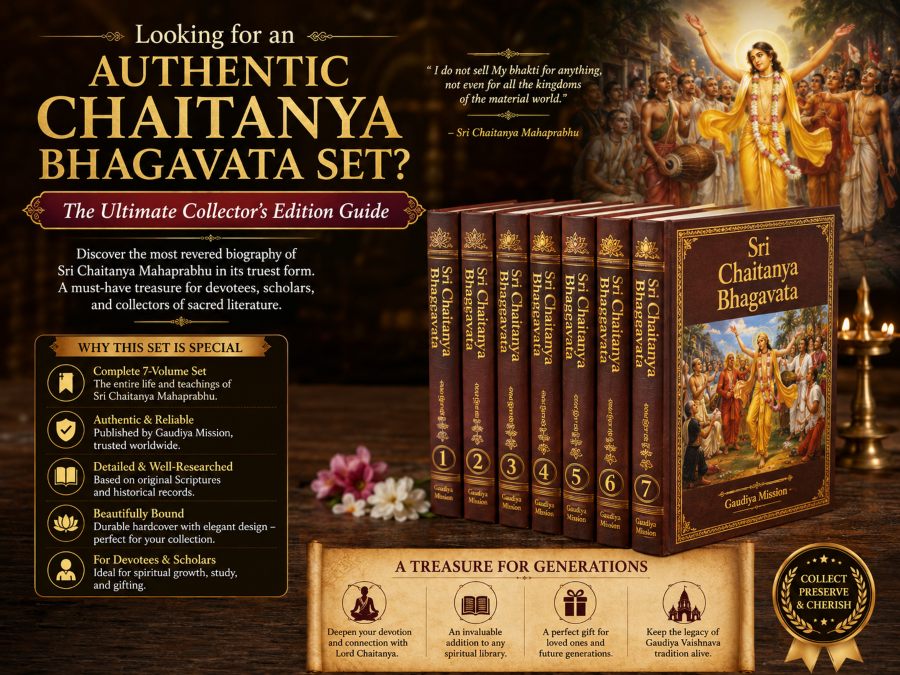
Looking for an Authentic Chaitanya Bhagavata Set? The Ultimate Collector’s Edition Guide
Let me tell you something most buyers find out the hard way.
They search for a Chaitanya Bhagavata Set, spend weeks comparing prices, and finally order what looks like a beautiful edition—and when it arrives, the paper feels cheap, the translation reads like it was run through a machine, and the binding starts loosening after a few months of regular use.
That’s not just disappointing. For a text this sacred and this historically significant, it feels almost disrespectful.
This guide exists to prevent exactly that. Whether you’re a serious devotee, a scholar of Vaishnava literature, or a collector who wants an edition worthy of your shelf — and your soul — you’re in the right place.
What Is the Chaitanya Bhagavata? (And Why It Matters So Much)
Before we talk editions, let’s be clear about what this text actually is. Because once you understand its weight, you’ll understand why getting the right set matters.
The Chaitanya Bhagavata was written by Vrindavana Dasa Thakura, a direct disciple of Nityananda Prabhu—one of the closest associates of Sri Chaitanya Mahaprabhu himself. The text was composed in English in the 16th century and is considered the foundational biography of Sri Chaitanya Mahaprabhu, the great saint and avatar who ignited the English Vaishnava movement.
It’s not just a biography. It’s theology. It’s devotional poetry. It’s a window into 16th-century Bengal—its language, its culture, and its spiritual electricity.
Chaitanya Mahaprabhu is considered by Gaudiya Vaishnavas to be the combined form of Radha and Krishna, who descended to experience the love of devotion from the inside. Vrindavana Dasa’s account of his life is often called the Adi Purana of Gaudiya Vaishnavism, and Vrindavana Dasa himself is called the “Vyasa of Chaitanya-lila”—the one who canonized the narrative.
Sri Chaitanya Mahaprabhu himself reportedly read the manuscript and expressed deep satisfaction. That endorsement alone tells you something.
The Three Kandas: Understanding the Structure
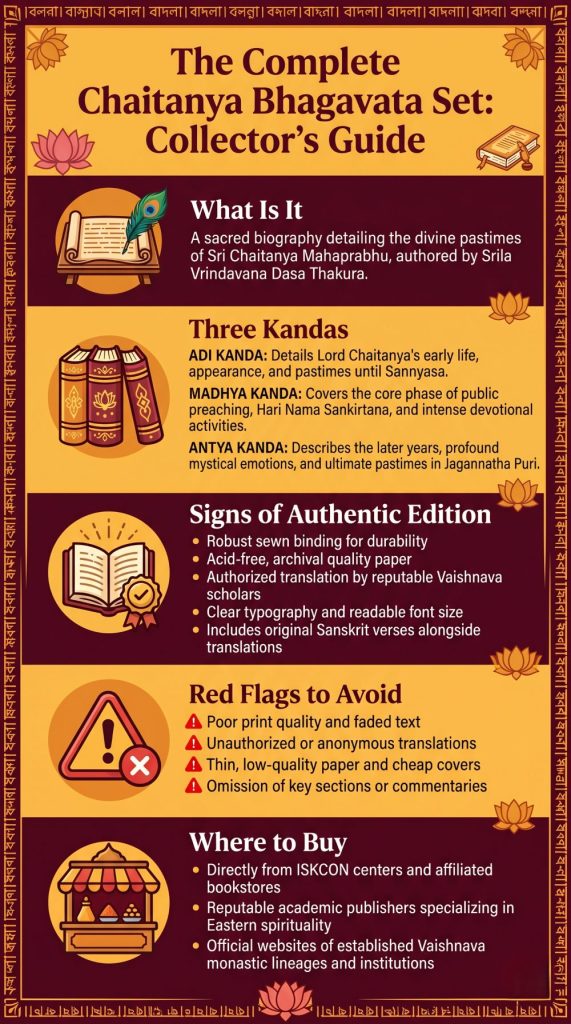
A complete Chaitanya Bhagavata Set consists of three sections—called “kandas”—each covering a different phase of Chaitanya Mahaprabhu’s life:
Adi Khanda (The Beginning)
Covers the birth of Mahaprabhu in Navadvipa, his childhood and youth, his education and early miracles, and his transformation into a devotee after his return from Gaya. This section is rich with tender, domestic scenes—Mahaprabhu as a child, as a student, as a young scholar whose brilliance startles everyone around him.
Madhya Khanda (The Middle)
This is the heart of the text. It documents the unfolding of the sankirtan movement in Navadvipa—the ecstatic group chanting that swept through Bengal like a fire. Mahaprabhu’s circle of devotees, their all-night kirtans, their confrontations with opposition, and their increasingly powerful spiritual experiences—it’s all here in extraordinary detail.
Antya Khanda (The Conclusion)
Covers the renunciation of Mahaprabhu—his taking of the sannyasa order—and his departure from Navadvipa. Notably shorter than the other two sections, but emotionally devastating in places. The grief of his mother, his wife, and his friends is rendered with heartbreaking directness.
A complete collector’s edition must include all three cantos in their entirety, with proper chapter breaks, commentary, and cross-references. Any set missing any of these is incomplete — don’t accept it.
What Separates a Genuine Collector’s Edition from a Generic Reprint?
This is the real question. And the answer has several layers.
1. Translation Quality
The Chaitanya Bhagavata is written in medieval Chaitanya English—a dialect that requires genuine scholarly expertise to translate faithfully. A poor translation flattens the poetry into bland prose and loses the theological nuances that make the text live.
Look for editions that include:
- Word-for-word Sanskrit/English meaning (anvaya)
- Free-flowing translation that reads as literature, not just information
- Purports or commentary by an established acharya or scholar
- Transliteration of the original verses for those who want to study the source language
The gold standard for many collectors is the edition translated and commented on by Bhaktisiddhanta Sarasvati Thakura, the great Vaishnava reformer of the early 20th century. His commentary is dense, scholarly, and theologically rich in a way that no casual translation can match.
2. Paper and Print Quality
Collector’s editions are meant to last decades — ideally, generations. Cheap paper yellows and becomes brittle. Thin pages allow ink bleed-through that makes reading painful.
What to look for:
- Cream or off-white acid-free paper — not stark white, which strains the eyes during long reading sessions
- Minimum 70 GSM paper weight—ideally 80-90 GSM for a proper feel
- Sharp, clean typography—English script especially requires precise printing; blurry letters are inexcusable
- No ink bleed-through—hold a page up to the light and it should be minimal
3. Binding
This is where many seemingly attractive editions fall apart—literally.
- Sewn binding (also called “Smyth-sewn”) is the benchmark. Pages are stitched in signatures before the cover is attached. Books bound this way can be opened flat without cracking the spine and can survive decades of regular use.
- Perfect binding (glued spine) is cheaper and common in mass-market paperbacks. It works fine for casual reading but will eventually crack and shed pages if you’re reading the same volume multiple times — which you will be.
- Hardcover with cloth boards is the collector’s preference. Leather-bound or leatherette versions exist and are beautiful but command a significant price premium.
4. Completeness of Editorial Apparatus
A serious edition should include the following:
- Detailed introduction — historical context, the life of Vrindavana Dasa, the text’s place in Vaishnava literature
- Index — names, places, concepts
- Glossary — Sanskrit and English terms explained
- Verse index — for reference and cross-citation
- Bibliography — for scholars who want to dig deeper
If an edition has beautiful covers but skips these elements, it’s a presentation piece, not a scholarly tool.
The Best Editions to Look For
Let’s get specific. Here are the editions that serious collectors and practitioners consistently recommend.
Gaudiya Math / Bhaktisiddhanta Editions
The editions published under the Gaudiya Math lineage — particularly those carrying the commentary of Bhaktisiddhanta Sarasvati Thakura — are considered definitive by many scholars. These editions have a long publication history, multiple revisions, and carry the theological weight of the sampradaya (tradition) itself.
They’re not always the most visually spectacular, but the substance is unmatched. If you’re a serious practitioner who intends to study this text deeply, this is your starting point.
What to check: Look for editions clearly marking which acharya’s commentary is included. The Bhaktisiddhanta commentary editions are distinct from generic translations.
Mayapur / ISKCON-Affiliated Editions
The International Society for Krishna Consciousness (ISKCON) and affiliated institutions have published various editions of the Chaitanya Bhagavata over the decades. Quality varies significantly across publishers and print runs.
The better ISKCON-affiliated editions benefit from:
- Access to extensive Vaishnava scholarly resources
- Widespread distribution (easier to find globally)
- Often available in multiple languages alongside English
Be careful with older print runs from the 1970s to ’90s—some have typographical errors and translation inconsistencies. More recent editions have improved significantly.
Academic / University Press Editions
For collectors who approach the text from a scholarly or comparative religion angle, certain academic publishers have produced critical editions of the Chaitanya Bhagavata with extensive historical notes, variant readings, and secondary literature.
These editions are invaluable for understanding the text’s manuscript tradition, its reception history, and its relationship to other Vaishnava texts. They are usually not designed for devotional use—the framing is analytical rather than reverential—but they are extraordinarily valuable for completeness of understanding.
Heritage English Editions from Kolkata Publishers
Several Kolkata-based publishers — some with over a century of history in English religious publishing — produce editions of the Chaitanya Bhagavata in the original Chaitanya English with extensive English commentary.
For readers who know English, these editions offer an experience that no translation can fully replicate. The original verse rhythms, the specific texture of Vrindavana Dasa’s language, the way certain phrases resonate in their original form — all of this is preserved.
Collectors who want to own a piece of living English literary tradition will find these editions irreplaceable.
Red Flags: What to Avoid When Buying
Over the years, a number of substandard editions have flooded the market—especially online marketplaces. Here’s what should make you pause:
Vague Attribution
If the set doesn’t clearly name the translator, commentator, and publisher—avoid it. Accountability matters. Anonymous translations of sacred texts are almost never good translations.
Suspiciously Low Price
A complete, high-quality three-volume set printed on good paper with proper binding costs money to produce. If something is priced dramatically below comparable editions, ask why. Usually the answer is in the paper, the binding, or the translation quality.
“Complete Set” That’s Actually a Single Volume
Some publishers compress all three kandas into a single thin volume. This is only possible by drastically abbreviating the text—cutting commentary, truncating chapters, and summarizing instead of translating. A genuine complete set is multiple volumes.
Poor English Script Quality
If you can read the original English verses and they look blurry, cramped, or inconsistent in letter size—that’s a print quality failure that signals larger production problems.
No Return Policy from Seller
Reputable publishers and booksellers stand behind their products. If a seller won’t allow returns on what they’re presenting as a premium edition, that’s a concerning signal.
Where to Actually Buy an Authentic Set
Directly from Established Vaishnava Institutions
This is often the best route. Many Gaudiya Math branches, ISKCON temple bookstores, and affiliated publishing houses sell directly to the public—either in person or online. Buying directly means you’re getting an edition the institution itself stands behind.
Key places to check:
- Gaudiya Math branches (Kolkata, Mayapur, and branches globally)
- ISKCON temple bookrooms—particularly larger centers like Mayapur, Vrindavan, Los Angeles, London
- Bhaktivedanta Book Trust (BBT) — ISKCON’s official publishing arm
- Visva-Bharati University publications (for academic editions)
Reputable Online Booksellers Specializing in Indian Religious Texts
Several established online retailers specialize in Sanskrit, English, and Vaishnava texts. Look for sellers with:
- Clear edition details (translator, publisher, year, number of volumes)
- Customer reviews that specifically mention reading/studying the text (not just display)
- Physical return policies
- Responsive customer service
Sites like Exotic India, Sanskrit Books, and Motilal Banarsidass (for academic editions) have established reputations.
Secondhand and Antiquarian Sources
For collectors, the secondhand market can yield extraordinary finds. Older editions—particularly those printed in the 1930s-60s in Calcutta—sometimes appear in:
- Estate sales and auctions
- Secondhand bookshops in Kolkata’s College Street area
- Online platforms like AbeBooks or rare book dealers specializing in South Asian texts
A well-preserved older edition from a reputable publisher can be both more authentic and more valuable than a new reprint. Inspect condition photographs carefully and ask about the binding, paper color, and whether all pages are intact before purchasing.
How to Care for Your Chaitanya Bhagavata Set
You’ve invested in an authentic edition. Now keep it that way.
Storage
- Store upright on a shelf, not stacked horizontally (stacking puts uneven pressure on spines)
- Keep away from direct sunlight—UV light yellows paper and fades covers faster than almost anything else
- Avoid humid environments—moisture warps pages and encourages mold growth
- A cool, dry, ventilated space is ideal
Handling
- Wash hands before handling, especially older or more delicate editions
- Don’t force a hardcover open to 180 degrees—this stresses the binding
- Use a ribbon bookmark rather than folding pages or using paper clips
For Devotional Use
In traditional Vaishnava practice, scripture is treated with reverence that also happens to be excellent preservation advice.
- The set should ideally be kept at a higher level than where you sit (placing sacred texts on the floor is considered disrespectful)
- Wrap in clean cloth when not in use — this also protects from dust
- Offer a moment of respect before opening for study
These aren’t just customs. They create a quality of attention that makes the reading experience richer and the physical book last longer.
Building a Complementary Vaishnava Library
The Chaitanya Bhagavata is the foundation, but serious collectors often want to understand it in context. Here are the texts that naturally complement it:
Chaitanya Charitamrita
By Krishnadasa Kaviraja Goswami — written later than the Chaitanya Bhagavata and considered the definitive biography of Mahaprabhu’s later life (particularly his years in Puri and his philosophical teachings). Together, the Chaitanya Bhagavata and Chaitanya Charitamrita give the complete picture.
Bhagavata Purana (Srimad Bhagavatam)
The text that Mahaprabhu himself considered supreme. Understanding the Bhagavatam is essential to understanding everything Chaitanya stood for. The A.C. Bhaktivedanta Swami Prabhupada translation and commentary (18 volumes, BBT) is the most widely available serious English edition.
Navadvipa Dhama Mahatmya
By Bhaktivinoda Thakura — a poetic glorification of the sacred sites of Navadvipa where Mahaprabhu lived. Beautiful companion reading to the Chaitanya Bhagavata.
Bhakti Rasamrita Sindhu
By Rupa Goswami — the systematic theology of devotional love (bhakti) as taught by Mahaprabhu’s Vrindavan disciples. This is where the emotional and theological insights of the Chaitanya Bhagavata get their philosophical framework.
The Collector’s Checklist Before You Buy
Quick summary. Before committing to any Chaitanya Bhagavata Set, verify:
- All three kandas (Adi, Madhya, Antya) are included in full
- Translator and commentator are clearly named
- Commentary is from a recognized acharya or scholar
- Paper is at least 70 GSM, acid-free if possible
- Binding is sewn, not just glued
- Original English verses are included (not just translation)
- Glossary and index are present
- Publisher is identifiable and has an established reputation
- You’ve seen actual photographs of the interior pages, not just the cover
A Personal Note for New Collectors
If this is your first time acquiring a serious Vaishnava text, something is worth saying directly.
This isn’t like buying a coffee-table book or even a standard religious text. The Chaitanya Bhagavata is a living document in the truest sense—practitioners have been reading it, chanting from it, weeping over it, and building their spiritual lives around it for five centuries.
The right edition doesn’t just sit on your shelf. It becomes part of your life. You’ll open it on particular days, read the same passages differently as you yourself change, and find lines that seem to speak directly to circumstances you’re living through.
That’s what a great text does. But it can only do that if the translation is honest, the commentary is deep, and the physical object is made with enough care to survive all those years of use.
Take your time choosing. Ask questions of sellers. If possible, physically hold an edition before buying it. The weight, the paper feel, the quality of the print—these things matter, and your hands will tell you things that photographs can’t.
A great Chaitanya Bhagavata Set is not just a purchase. It’s an inheritance you’re taking into your custody—one that, if you choose well, you can eventually pass on.