

The Spiritual Legacy of Vrindavana Das Thakura: Lessons in Humility and Grace
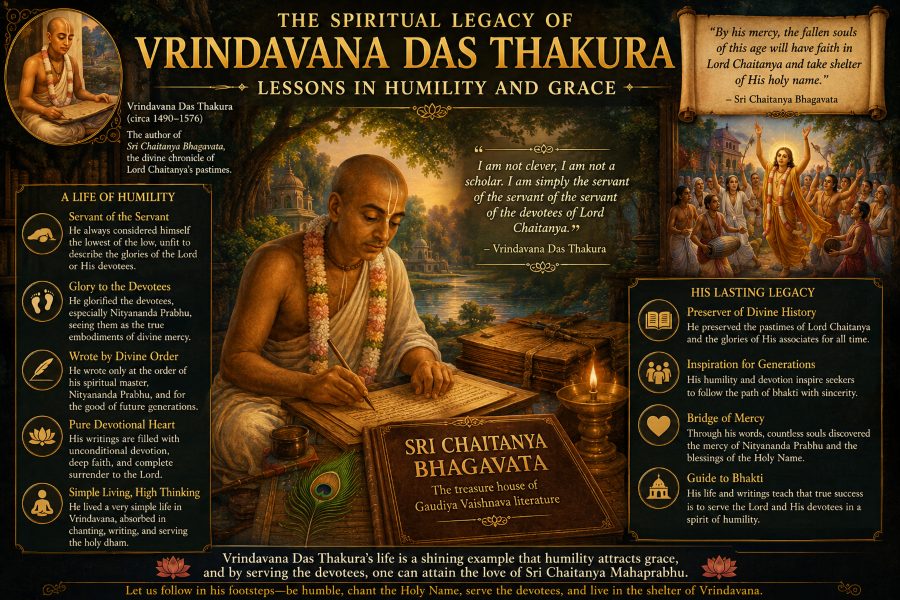
In the vast garden of Vaishnava saints, certain figures shine with a quiet, enduring light that does not demand attention but simply cannot be ignored once encountered. Vrindavana Das Thakura is one such figure. He is not as widely known in popular spiritual culture as some of the names that surround him — and that obscurity is itself, in a strange way, a reflection of his essential character. He did not seek recognition. He sought only to serve. And in that single-pointed service, he produced one of the most treasured documents in the entire Vaishnava tradition: the Chaitanya Bhagavata, a biography of Sri Chaitanya Mahaprabhu that captures the early and middle portions of the Golden Avatar’s life with an intimacy, a devotional fervor, and a literary brilliance that has never been surpassed. For those who wish to explore the life, teachings, and literary legacy of Vrindavana Das Thakura through authentic editions and devotional texts rooted in the living Vaishnava tradition, the resources available carry the same spirit of sincerity that defined this great saint’s entire existence.
Who Was Vrindavana Das Thakura?
To understand the legacy of Vrindavana Das Thakura, one must first understand the world he was born into — because that world was, quite literally, the world of Sri Chaitanya Mahaprabhu himself.
Vrindavana Das Thakura was born in the late fifteenth or early sixteenth century in the village of Mamgachi, near Navadvipa in Bengal. His mother, Narayani Devi, was the niece of Srivasa Thakura — one of the most intimate associates of Sri Chaitanya and a central figure in the early sankirtana movement. This lineage is not merely biographical detail. It is the key to understanding why Vrindavana Das Thakura’s writing carries the authority and the emotional texture that it does.
As a small child, Narayani had received the direct mercy of Sri Chaitanya himself. On one occasion, described in the Chaitanya Bhagavata, Chaitanya placed his hand on the young girl’s head and caused her to taste the nectar of krishna-nama — the divine name — directly. The ecstasy she experienced in that moment was the seed planted in the family line, and Vrindavana Das Thakura was the flower that grew from it.
He received initiation from Nityananda Prabhu — Sri Chaitanya’s closest associate, often described as his other self, the embodiment of divine grace and unconditional mercy. This disciplic connection defined Vrindavana Das Thakura’s entire devotional orientation. Nityananda Prabhu was famous for extending the mercy of Sri Chaitanya to those whom conventional society had written off — the fallen, the addicted, the violent, the spiritually unqualified. His mercy was not conditional on eligibility. It was a flood that swept everything in its path. That same quality of unconditional, grace-saturated devotion flows through every page of everything his disciple produced.
Sri Chaitanya Mahaprabhu himself, in one recorded instance, referred to Vrindavana Das Thakura as Vyasa — the Vedic sage credited with compiling and organizing the entire corpus of Vedic knowledge. This is not a casual honorific. In the Vaishnava tradition, to call someone Vyasa is to say that their literary contribution to the transmission of sacred knowledge is of the highest possible order. Sri Chaitanya was identifying Vrindavana Das Thakura’s role in the tradition before the work had even been completed — a recognition that speaks both to the saint’s spiritual depth and to the divine foreknowledge of the one making the declaration.
The Chaitanya Bhagavata: A Book Born of Direct Connection
The Chaitanya Bhagavata is not a scholarly biography. It is not a theological treatise. It is something rarer and more precious: the record of a life in motion, captured by someone who was, through his mother and his spiritual master, directly connected to the events being described.
When Vrindavana Das Thakura wrote about the early years of Sri Chaitanya in Navadvipa — the mischievous childhood, the blazing intellect, the transformative journey to Gaya, the eruption of devotional ecstasy that followed — he was writing from a living tradition, not a historical record. The people described in these pages were people his mother had known. The streets of Navadvipa where Chaitanya walked were streets his own family had walked. The kirtan that electrified entire neighborhoods in those early years was a current that had passed through his own family line.
This gives the Chaitanya Bhagavata a texture that no purely scholarly account can replicate. The writing is alive. It is saturated with the bhava — the devotional mood — of someone who is not merely reporting but reliving and transmitting. Reading it, one does not feel that one is receiving information. One feels that one is being taken somewhere.
The text is organized into three sections — Adi Khanda (the early portion), Madhya Khanda (the middle portion), and Antya Khanda (the later portion) — though it is the first two sections that form the heart of the work. Antya Khanda remains incomplete, and the tradition holds that this incompleteness was intentional — a humility gesture from an author who felt that the final, most intimate chapters of Chaitanya’s life in Puri, his deepening absorption in the ecstasy of divine separation, were too sacred for his pen to fully capture. He left that territory for Krishnadasa Kaviraja Goswami, who would later produce the Chaitanya Charitamrita — picking up, in a sense, where Vrindavana Das Thakura’s humility had paused.
That gesture — stopping not because of inability but because of reverence — tells you almost everything you need to know about the character of the man.
Humility as a Spiritual Technology
One of the most consistent features of Vrindavana Das Thakura’s character, as preserved in the tradition and expressed in his writing, is a quality of humility that is not performative but structural — built into the very way he understood himself in relation to the subject he was writing about.
Throughout the Chaitanya Bhagavata, the author regularly interrupts his own narrative to make statements of self-deprecation that, in a lesser writer, might read as false modesty. In Vrindavana Das Thakura, they read as genuine orientation. He describes himself as fallen, as unqualified, as someone whose only hope of conveying anything true about Sri Chaitanya lies entirely in the mercy of his spiritual master Nityananda Prabhu and the subject of his writing himself.
This is not merely literary convention. In the Vaishnava tradition, the trnad api sunicena verse from Sri Chaitanya’s own Shikshashtakam — “one who is humbler than a blade of grass, more tolerant than a tree, who gives honor to others without desiring it for oneself” — describes not just a recommended attitude but the actual internal condition that makes authentic spiritual transmission possible. A teacher or writer who is puffed up with their own spiritual status creates a barrier. Their ego stands between the reader and the reality being described. Vrindavana Das Thakura’s consistent self-effacement creates the opposite — a transparency through which the reader encounters not the author’s personality but the living presence of Sri Chaitanya himself.
This is a lesson with direct practical application for any serious spiritual practitioner. Humility, in this tradition, is not low self-esteem. It is the accurate recognition of one’s position in relation to the Absolute — and that recognition, paradoxically, makes one a far more effective vehicle for spiritual transmission than any amount of qualification or learning unaccompanied by it.
The greatest teachers in the Vaishnava tradition have consistently pointed to Vrindavana Das Thakura as a living illustration of this principle. His qualifications were extraordinary — direct family connection to Chaitanya’s inner circle, initiation from Nityananda Prabhu, literary gifts of the highest order. And yet the use he made of all those gifts was to place them entirely in service of the subject, never in service of self-promotion. The result is a work that has survived five centuries without diminishing — because it carries no ego-residue to decay.
Grace: The Theological Cornerstone
If humility is the defining personal quality of Vrindavana Das Thakura, grace is the defining theological theme of everything he wrote.
The specific form of grace that pervades the Chaitanya Bhagavata is the grace of Nityananda Prabhu — and understanding what that means requires a brief excursion into Vaishnava theology.
Nityananda Prabhu is understood, in the Gaudiya Vaishnava tradition, as an avatara of Balarama — Krishna’s elder brother and closest companion, the embodiment of the guru-tattva, the principle of the spiritual master. If Sri Chaitanya represents the sweetness and the depth of divine love, Nityananda represents the active, outpouring mercy that makes that love accessible to those who have no claim on it.
There is a famous account, preserved in both the Chaitanya Bhagavata and the Chaitanya Charitamrita, of Nityananda Prabhu’s encounter with two incorrigible reprobates — Jagai and Madhai — who were feared throughout Navadvipa for their violence, their drunkenness, and their general degradation. When Nityananda attempted to approach them with the invitation to chant the divine name, they attacked him physically, drawing blood. Sri Chaitanya, witnessing this, moved to respond with divine anger. Nityananda intervened — not to protect himself but to protect Jagai and Madhai from the consequences of their own action. His argument was simple and devastating: if you save only the qualified, what is the glory in that? The glory of mercy is revealed precisely in saving those who deserve nothing.
This is the theological position that Vrindavana Das Thakura absorbed from his spiritual master and transmitted through every page of his writing. Grace, in this framework, is not a reward for spiritual achievement. It is the fundamental nature of the divine relationship with the fallen soul — unconditional, preemptive, and operating independently of any calculation of merit.
The practical implications of this are enormous. A spiritual tradition that understands grace in this way cannot, in principle, exclude anyone. It cannot establish a hierarchy of the deserving. It cannot require prior qualification as a condition for divine mercy. And it cannot — this is perhaps the most radical implication — treat any soul as beyond redemption. Vrindavana Das Thakura’s rendering of the Jagai-Madhai episode is among the most powerful in the entire text, precisely because he understood, from the inside, what it meant to be a recipient of that unconditional mercy through his own connection to Nityananda Prabhu.
Read Also:- Unsolved Magic of ISKCON Mayapur
Literary Genius in the Service of Devotion
It would be a disservice to Vrindavana Das Thakura to discuss his spiritual legacy without acknowledging the sheer literary quality of his achievement.
The Chaitanya Bhagavata is written in Bengali verse — specifically in the payar and tripad meters that were the primary vehicles of devotional literature in medieval Bengal. Within those traditional forms, Vrindavana Das Thakura demonstrates a range that moves from the quietly intimate to the cosmically grand, from the tenderly domestic to the philosophically acute, often within the span of a few verses.
His descriptions of the childhood of Sri Chaitanya in Navadvipa — the mischievous theft of offerings, the sudden episodes of ecstatic vision that bewildered his family, the way his mother Sachi watched her extraordinary son with a mixture of maternal anxiety and dawning recognition — these passages have a novelistic intimacy that feels startlingly modern. The people are real. Their emotions are complex. Their relationship to the divine reality unfolding in their midst is not uncomplicated awe but the messy, beautiful mixture of doubt, love, confusion, and surrender that characterizes authentic human encounter with the sacred.
His descriptions of the sankirtana movement — the processions of chanting that swept through the streets of Navadvipa, drawing everyone into their current — have an almost cinematic quality. The sound, the color, the movement, the emotional electricity of thousands of people united in divine name — Vrindavana Das Thakura renders all of it with a vividness that makes the reader feel not like a student reading history but like a participant being swept along in the current.
And his doctrinal passages — where he pauses the narrative to explain the theological significance of what has just occurred — demonstrate a philosophical clarity and precision that confirms the assessment of Sri Chaitanya himself: this is a Vyasa-level intellect, capable of transmitting the deepest truths in language that both scholars and ordinary devotees can receive.
The Question of Canonical Status
Within the Gaudiya Vaishnava tradition, the Chaitanya Bhagavata occupies a position of extraordinary canonical authority — though the nature of that authority deserves careful articulation.
The Chaitanya Charitamrita of Krishnadasa Kaviraja Goswami is generally regarded as the more philosophically comprehensive of the two major biographies of Sri Chaitanya. It covers more of Chaitanya’s life, particularly the later Puri years, and its theological depth is unrivaled. But the Chaitanya Bhagavata holds something the Charitamrita cannot: temporal proximity to the events described, and the living transmission of a devotional atmosphere that existed in the immediate circle of Chaitanya himself.
Krishnadasa Kaviraja Goswami explicitly acknowledges his debt to Vrindavana Das Thakura in the Chaitanya Charitamrita, offering him reverence as the Vyasa of the Chaitanya tradition. He describes the Chaitanya Bhagavata as the foundation on which his own work rests. Without Vrindavana Das Thakura’s prior labor, the Charitamrita — which came several decades later — could not have been written with the authority and completeness it achieves.
This relationship between the two texts mirrors, in a meaningful way, the relationship between the Srimad Bhagavatam and earlier Puranic literature: each successive text builds on what came before, not replacing it but deepening and completing it. The serious student of the Chaitanya tradition reads both, in sequence, and finds that they illuminate each other in ways that neither can fully achieve alone.
Lessons That Cross Every Century
What does Vrindavana Das Thakura’s legacy mean for a person living in the twenty-first century, possibly thousands of miles from Bengal, with no prior background in Vaishnava tradition?
The answer is more direct than one might expect.
The first lesson is the power of a life in service. Vrindavana Das Thakura did not set out to build a reputation or establish a philosophical school. He set out to serve Sri Chaitanya — to record his lord’s glory as faithfully and as beautifully as he could, and to offer that record to whoever might benefit from it. The reputation, the canonical status, the centuries of reverence — all of this arrived as a byproduct of service, not as its goal. This is a principle with application far beyond the devotional context. Any creative or intellectual work undertaken in the spirit of genuine service rather than self-promotion tends to outlast work produced with the opposite motivation.
The second lesson is the transformative power of lineage and connection. Vrindavana Das Thakura’s access to the living tradition of Sri Chaitanya came through his mother’s connection to Srivasa Thakura and his own initiation through Nityananda Prabhu. He did not arrive at his understanding through independent study or personal insight alone. He received it — through a human chain of transmission that carried not just information but the living current of devotional realization. In an era that valorizes the self-made spiritual seeker, this is a countercultural message worth sitting with.
The third lesson is the inseparability of humility and effectiveness. In five centuries, the Chaitanya Bhagavata has not lost a single reader for want of authority or depth. Yet its author consistently described himself as unqualified. The paradox resolves when one understands that true humility — not the performance of smallness but the genuine recognition of one’s position — creates a vehicle that the divine can use without obstruction. Vrindavana Das Thakura’s ego did not stand between the reader and Sri Chaitanya. And so Sri Chaitanya, through those pages, still meets the reader directly.
Living the Legacy Today
The tradition that Vrindavana Das Thakura helped establish is not a closed archive. It is, as noted above, a living river — and it continues to flow into new territories and new hearts in every generation.
The Chaitanya Bhagavata is available today in translation, with commentary, for English-speaking readers who could not have encountered it even fifty years ago. The lineage of Nityananda Prabhu — through Srila Prabhupada and the Gaudiya Vaishnava institutions he established — continues to transmit the same current of unconditional grace that Vrindavana Das Thakura received and recorded. The stories of Jagai and Madhai are still being told, and the implication of those stories — that no one is beyond the reach of divine mercy — is still as radical, as subversive, and as liberating as it was in fifteenth-century Navadvipa.
To engage with the legacy of Vrindavana Das Thakura is not to enter a museum. It is to step into a stream that is still moving, still capable of carrying anyone who enters it, and still flowing from the same inexhaustible source that the Golden Avatar of Bengal drew upon when he danced through the streets of Navadvipa five centuries ago.
The humility and grace that defined Vrindavana Das Thakura’s life are not biographical curiosities. They are invitations — extended across centuries, to anyone willing to receive them.
Explore authentic editions of the Chaitanya Bhagavata and other foundational Vaishnava texts rooted in the living tradition of Sri Chaitanya Mahaprabhu at Mayapur Store — trusted by devotees and seekers around the world.