


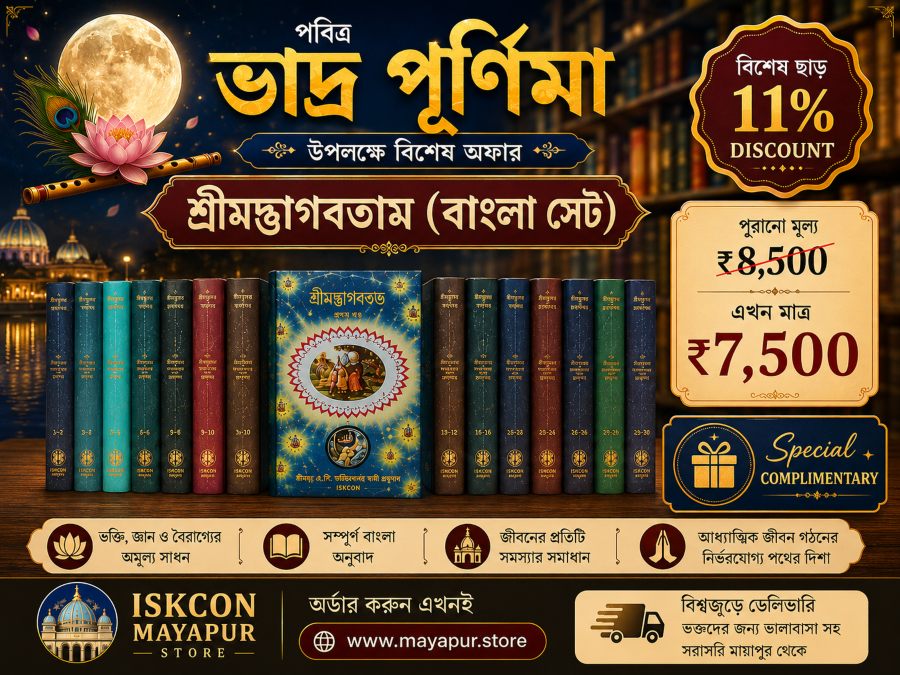
Ever wondered why some Bengali households keep an entire shelf reserved for eighteen books, wrapped carefully in cloth, dusted every single day? That’s not decoration. That’s devotion, built one volume at a time.
For millions of Vaishnava families across Bengal, the Srimad Bhagavatam isn’t something you read once and put away. It’s closer to a daily companion—something you return to, verse by verse, for years, sometimes for an entire lifetime. And when that scripture arrives as a complete 18-volume Bengali edition, sourced directly through ISKCON Mayapur Store, it stops being just literature on a shelf. It becomes a practice you build your days around.
This guide walks through everything worth knowing before you bring this particular set home — what’s actually inside the eighteen volumes, why the Bengali translation matters more than people assume, and who genuinely benefits from owning the full set instead of picking up a single canto here and there.
What Is the Srimad Bhagavatam, Really?
Strip away the reverence for a second and ask a simple question: what is this book actually about?
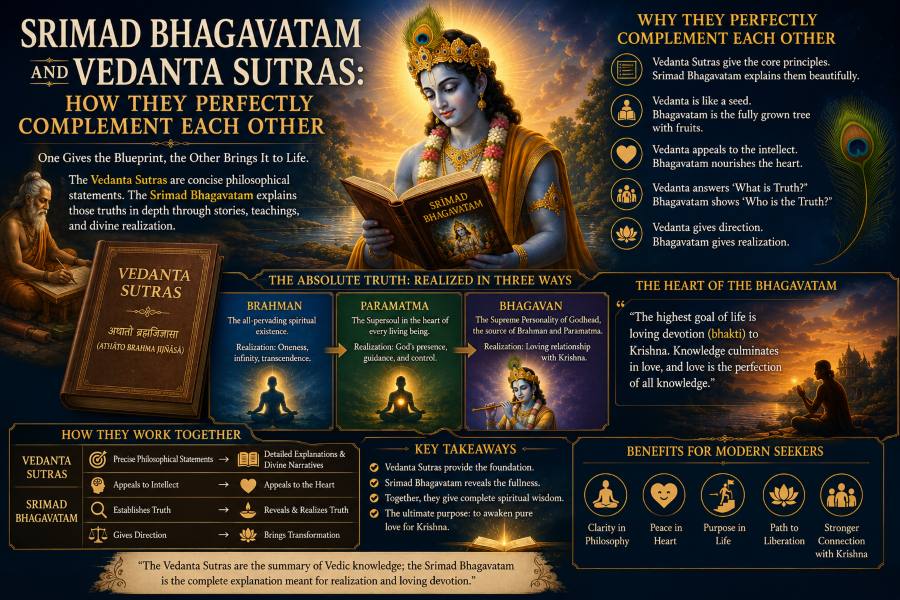
At its core, the Srimad Bhagavatam is a conversation. A dying king, Maharaja Parikshit, has seven days left to live. A young sage, Sukadeva Goswami, sits beside him and answers the one question every person eventually asks—what happens after this life, and how should I have lived it?
That conversation stretches across twelve cantos and roughly eighteen thousand verses. It covers the creation of the universe, the nature of time, the pastimes of various incarnations of the Supreme Lord, and — most famously in the Tenth Canto — the life of Lord Krishna in Vrindavana and Dwaraka.
What sets the Bhagavatam apart from other Puranas isn’t just its length. It’s the way it keeps circling back to one idea: that devotion, not ritual or knowledge alone, is the direct path to the divine. Every story, every philosophical digression, eventually lands back on that point.
Why Bengali Readers Deserve More Than a Rough Translation
Here’s something people rarely think about until they’re already holding the wrong edition: not all translations carry the same weight.
Sanskrit is a language built on layered meaning. A single word can carry grammatical mood, emotional tone, and philosophical implication all at once. Translate it carelessly, and you get a technically accurate sentence that misses the actual point Sukadeva Goswami was making.
This is where a proper Bengali edition earns its place. Bengali as a language sits closer to Sanskrit in structure and rhythm than most modern Indian languages, which means a well-done translation can preserve nuance that gets flattened in English or Hindi versions.
A few things a strong Bengali translation should do:
- Keep the poetic meter intact where possible, so verses still read like verses, not flat prose
- Preserve technical Sanskrit terms with proper Bengali glosses instead of forcing awkward substitute words
- Carry Srila Prabhupada’s purports faithfully, since the commentary often matters as much as the verse itself
- Read naturally out loud, because this is a text meant to be recited, not just silently scanned
When a translation does these things well, something interesting happens — readers stop feeling like they’re studying a foreign text and start feeling like the book is speaking directly to them.
Inside the Box: What 18 Volumes Actually Gives You
Numbers can be misleading. “Eighteen volumes” sounds like a lot until you realize the Bhagavatam’s Tenth Canto alone—covering Krishna’s life—is often split across four separate books because of its sheer scope.
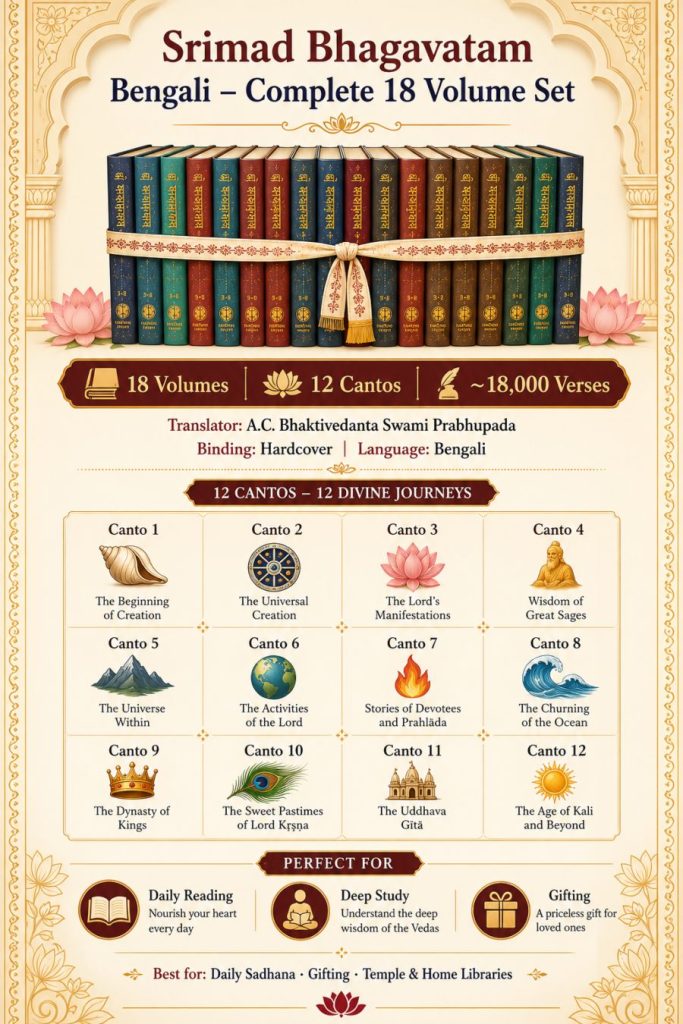
Here’s roughly how a complete Bengali 18-volume set breaks down:
- Canto 1 — Introduction, the sage Narada’s teachings, and the background to Parikshit’s final days
- Canto 2 — The cosmic form of the Lord and the process of creation
- Canto 3 (2 parts) — Deeper cosmology, the story of Kapiladeva, and Devahuti’s spiritual journey
- Canto 4 (2 parts) — King Dhruva, King Prithu, and several important genealogies
- Canto 5 — The structure of the universe and the story of Bharata Maharaja
- Canto 6 — The story of Ajamila and the power of chanting the holy name
- Canto 7 — Prahlada Maharaja and Lord Nrsimhadeva
- Canto 8 — The churning of the ocean and the story of Bali Maharaja
- Canto 9 — Dynastic histories leading up to Krishna’s appearance
- Canto 10 (4 parts) — Krishna’s birth, childhood in Vrindavana, youth, and the events in Dwaraka
- Canto 11 (2 parts) — Krishna’s final teachings and the Uddhava Gita
- Canto 12 — Predictions about the age of Kali and the conclusion of the narrative
Owning the full set means you’re never stuck mid-story. Anyone who’s tried reading a single volume picked up secondhand knows the frustration of hitting a reference to an earlier event with no way to look it up. Eighteen volumes solve that problem permanently.
Notice something else about that breakdown — several cantos split into two, three, or even four separate parts. That’s not arbitrary packaging. The Tenth Canto alone covers Krishna’s birth, His childhood pastimes in Vrindavana, His youth among the cowherd community, and later His years ruling from Dwaraka. Trying to compress that into one volume would mean either shrinking the print size to an uncomfortable point or cutting content — and a faithful edition doesn’t cut content just for convenience.
This is also why buying loose, mismatched volumes from different sellers rarely works out well. Print runs, page numbering, and even purport formatting can shift slightly between editions printed years apart. A complete set purchased together avoids that inconsistency entirely.
Sanskrit, English, or Bengali — Which Edition Should You Actually Read?
This question comes up more often than people expect, especially in households where multiple generations read at different comfort levels.
Sanskrit-only editions preserve the original verses exactly, but they demand a level of classical language training most readers — even fairly religious ones — simply don’t have anymore. Reading Sanskrit shlokas without a translation isn’t really reading; it’s reciting sounds without grasping meaning, which defeats the purpose for anyone hoping to actually understand the philosophy.
English editions solve the comprehension problem for a global audience, and that’s exactly why Prabhupada prioritized English translations early in his mission—to reach as many people as possible, as quickly as possible. But for a native Bengali speaker, reading philosophy in a second language adds a layer of mental translation that can dull the emotional impact of certain verses, particularly the more poetic or devotional passages.
Bengali editions sit in a useful middle position for Bengali-speaking readers specifically:
- The grammar and vocabulary feel native, so there’s no mental lag between reading a sentence and absorbing its meaning
- Devotional terminology—words like “bhakti,” “prema,” and “vairagya”—often carries closer emotional resonance in Bengali than in translated English equivalents
- Reading aloud during family satsang or kirtan gatherings flows more naturally when the language matches the spoken language of the household
None of this makes one edition objectively “better” than another. It simply means the right choice depends on who’s actually going to be reading it, day after day, for years.
Who Actually Wrote This — and Why That Matters
The name printed on the cover is Krishna Dwaipayana Vyasa, the sage traditionally credited with compiling the Vedic literature, working through Sukadeva Goswami as the narrator. But the English and Bengali translations most readers encounter today come from His Divine Grace A.C. Bhaktivedanta Swami Prabhupada, founder of ISKCON.
Why does the translator’s identity matter for a scripture this old? Because commentary shapes understanding. Prabhupada didn’t just translate words—he added purports after nearly every verse, connecting ancient philosophy to questions a modern reader actually asks. Those purposes are often what turn a difficult Sanskrit verse into something a person can genuinely apply to their own life.
This is also why authenticity matters when buying a set like this. A translation stripped of its original purports, or edited without proper authorization, loses exactly the part that made Prabhupada’s edition so widely trusted in the first place.
Hardcover, Print Quality, and Why the Physical Book Still Matters
In an age of PDFs and audiobooks, it’s fair to ask whether a physical hardcover set is even necessary anymore.
For a text like the Bhagavatam, the answer tends to be yes, and not for sentimental reasons alone.
- Durability — A book read daily for decades needs binding that survives that kind of handling. Hardcover editions are built for exactly this.
- Marginalia and bookmarks — Serious readers annotate, underline, and return to specific verses repeatedly. A screen makes this clumsy; a physical page doesn’t.
- Ritual weight — For many Vaishnava households, the book itself is treated with reverence—kept on a clean shelf, not placed on the floor, and opened with washed hands. That relationship is harder to build with a digital file.
- No dependency on devices or charging — A book doesn’t need a battery, an app update, or an internet connection to be read at 4 AM before sunrise sadhana.
None of this means digital versions are useless — they’re great for quick reference or travel. But for the kind of long-term, daily relationship most readers build with the Bhagavatam, a well-bound hardcover set tends to win out.
Who Should Buy the Full Set (And Who Might Wait)
Not everyone needs all eighteen volumes on day one, and it’s worth being honest about that.
This set makes sense if you:
- Read Bengali comfortably and want the scripture in your first language rather than a second-language translation
- Are already committed to daily scriptural reading, not just curious about trying it once
- Want a complete home or temple library rather than a single introductory volume
- Plan to teach or share the text with family, students, or a local satsang group
- Are gifting the set for a wedding, thread ceremony, or other auspicious occasion where a complete scripture carries real significance
You might start smaller if you:
- Have never read any canto of the Bhagavatam and want to test whether the reading style suits you first
- Are more comfortable in English or Hindi than Bengali
- Have limited shelf space or are reading primarily in short digital bursts rather than sitting with a physical book
There’s no shame in starting with Canto One before committing to the full eighteen. But for readers who already know this is a lifelong relationship, buying the complete set upfront usually works out better — both financially and practically, since matching individual volumes later can be harder than expected.
Daily Reading vs. Deep Study: Two Very Different Ways to Use This Set
People tend to approach the Bhagavatam in one of two ways, and it helps to know which one describes you before you start.
Daily reading looks like this: a fixed time each morning or evening, a few verses at a time, moving steadily through the cantos over months or years without rushing. This approach treats the book the way one might treat a daily walk—small, consistent, cumulative.
Deep study looks different: sitting with a single verse or story for an extended period, cross-referencing passages, maybe discussing it with others in a study circle, and sometimes returning to the same passage multiple times across different years as understanding deepens.
Most long-term readers end up doing both at different points in their life. Early on, daily reading builds familiarity with the overall structure. Later, certain stories—Prahlada’s unwavering faith, Ajamila’s transformation, and the Uddhava Gita’s final teachings—pull readers back for closer study once they’ve lived enough life to appreciate what’s actually being said.
Having the full 18-volume set makes both approaches possible without ever hitting a gap where “the next volume isn’t available yet.”
There’s a third pattern worth mentioning too, though it’s less common: seasonal reading, where readers move through specific cantos around specific times of year. The Tenth Canto’s Vrindavana pastimes, for instance, often get revisited around Janmashtami. The story of King Bharata sometimes gets picked up around personal milestones—a reminder about attachment and detachment that hits differently depending on where someone is in life. Owning the complete set means these seasonal returns are always possible without hunting for a borrowed copy each time.
What almost every long-term reader agrees on, regardless of which pattern they follow, is that rereading matters more than reading fast. The Bhagavatam isn’t structured like a novel building toward a single twist ending. It’s structured like a spiral — the same core truths about devotion and detachment get revisited from different angles across all twelve cantos. A reader who finishes all eighteen volumes once has really only had a first conversation. The real understanding tends to arrive on the second or third pass through, once the earlier stories start echoing against the later ones.
Gifting the Bhagavatam: An Old Tradition That Still Holds Up
Among Bengali Vaishnava families, gifting scripture isn’t unusual—it’s expected at certain life stages. A wedding, a child’s sacred thread ceremony, moving into a new home, or simply marking someone’s return to serious spiritual life are all occasions where a complete Bhagavatam set shows up as a gift.
What makes it work as a gift, compared to something more generic, is permanence. A set of eighteen hardcover volumes isn’t consumed or worn out the way most gifts are. It sits in a home for decades, often getting passed down when the original recipient is no longer able to read it themselves.
If you’re considering this as a gift, a few small touches matter:
- Check the recipient’s comfort with Bengali before assuming it’s their preferred language
- Confirm shelf space—eighteen hardcover volumes need a proper spot, not a cramped corner
- Consider timing it around an auspicious date on the Vaishnava calendar, since many families prefer receiving scripture on days already associated with spiritual significance
Buying From a Trusted Source Actually Matters Here
This might be the single most overlooked part of buying a scripture set like this. People spend time comparing print quality and binding, then buy from whichever listing shows up first in a search result—without checking whether the edition is even authorized.
Unauthorized reprints of the Bhagavatam exist, and they tend to cut corners in ways that aren’t obvious until you’re already reading. Missing parts, altered wording, cheaper paper that yellows within a year—these problems show up after the purchase, not before.
Buying through a source connected directly to ISKCON Mayapur removes that guesswork. The temple’s own online store sources books directly from BBT (the Bhaktivedanta Book Trust), which means the translation, the purports, and the print quality all match what Srila Prabhupada’s mission originally intended—nothing altered, nothing shortened.
If you’ve already decided this is the edition you want, the Srimad Bhagavatam Bengali 18 Volume Set listing carries full authenticity assurance, along with shipping handled directly by the temple’s own team rather than a third-party reseller. That distinction — buying from the mission itself rather than from someone reselling temple stock — is exactly what protects you from the incomplete or altered reprints mentioned earlier.
A Few Honest Questions People Ask Before Buying
Is the Bengali translation harder to find than English or Hindi editions? Yes, generally. Complete 18-volume Bengali sets are printed in smaller runs than English editions, which is part of why sourcing from a dedicated store matters — availability isn’t guaranteed everywhere.
Can a beginner start directly with this full set? Absolutely, though most beginners find it easier to start reading Canto One first, then work through the rest at their own pace rather than trying to absorb everything at once.
Does the hardcover binding hold up to years of daily use? Well-bound hardcover editions are designed exactly for this kind of repeated daily handling, which is part of why the binding quality is worth checking before buying.
Is this suitable for children or only for adult readers? Both, in different ways. Younger readers often start with simplified retellings of specific stories—Prahlada, Dhruva, and Krishna’s childhood—before moving into the full text as they grow older.
How long does it realistically take to read all eighteen volumes? There’s no single answer, and anyone claiming otherwise is probably guessing. Readers doing a few pages a day as part of a fixed morning routine often take two to three years to complete a first full pass through all twelve cantos. That’s not slow—for a text this dense, moving quickly usually means missing what the authors are actually trying to explain.
Do I need to read the cantos strictly in order? For a first read, yes, since later cantos regularly assume familiarity with earlier events and characters. After completing at least one full pass, many readers do jump around—returning to a favorite story or canto without following the original sequence.
What’s the difference between this edition and a condensed or summarized version? Condensed editions strip out most of Prabhupada’s purports and keep only the core narrative, which makes them faster to read but far shallower. A complete 18-volume set keeps every purpose intact, which is really where most of the practical, applicable teaching actually lives—the verses set up the story, but the purposes explain what it means for someone living an ordinary life today.
Bringing It All Home
A book this size asks something of the reader that most books don’t—patience, return visits, and a willingness to sit with ideas that don’t resolve in a single sitting. That’s not a flaw in the Bhagavatam. It’s the entire point of a text meant to be lived with rather than finished.
Whether you’re building a home library, gifting a complete set for a milestone occasion, or simply ready to move past a single borrowed volume, an authentic 18-volume Bengali edition gives you the whole conversation — from Parikshit’s final week to Krishna’s own last teachings — without a single gap in between.
For readers who’d rather browse other cantos, translations, or related editions before deciding, the full Srimad Bhagavatam collection is worth exploring first—it’s a simple way to compare formats side by side before committing to the complete set.