


What If the World’s Greatest Epic Was Actually Eighteen Stories That Build One Extraordinary Journey?
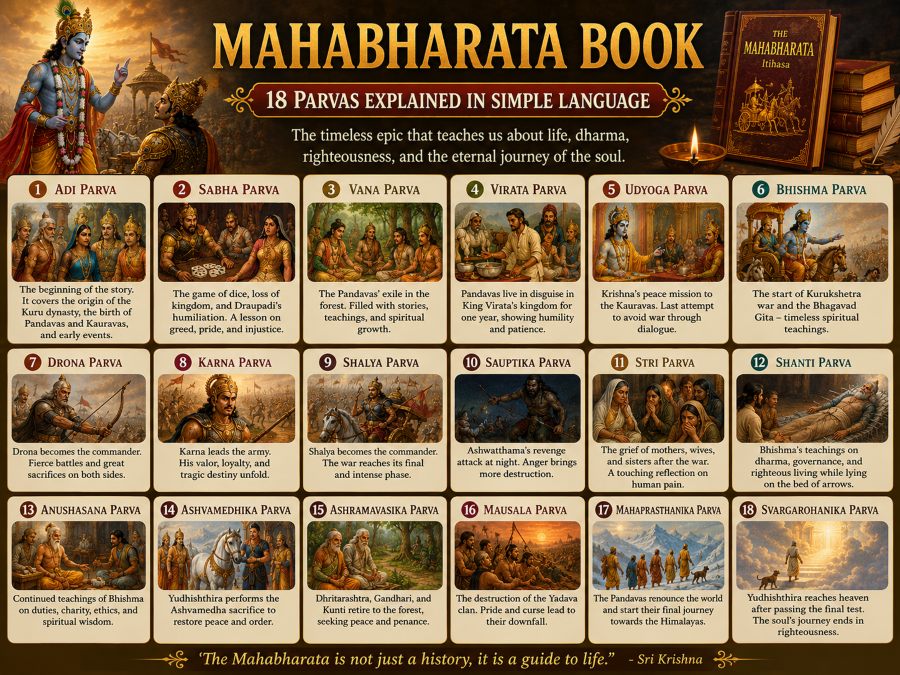
Most people know the Mahabharata because of the Kurukshetra War or the timeless teachings of the Bhagavad Gita. Yet many readers are surprised to discover that the Mahabharata Book is carefully organized into 18 Parvas, or major sections, each representing a different stage of an unforgettable journey. Readers looking for authentic editions often begin their study through the Official ISKCON Mayapur Store, where Vedic scriptures are presented with trusted translations and traditional commentary.
Rather than treating the Mahabharata as one continuous story, think of it as eighteen connected chapters of life itself. Every Parva introduces new people, difficult choices, unexpected victories, heartbreaking losses, and profound spiritual lessons. Together, they create a complete picture of human nature, leadership, devotion, justice, and the eternal search for truth.
This guide explains each Parva in simple language while also revealing why every section matters. By the end, you’ll see that the Mahabharata is much more than an epic—it is a map of life’s greatest challenges and highest ideals.
Why Is the Mahabharata Divided into 18 Parvas?
The division is far more than a convenient way to organize a long book.
Each Parva represents a distinct phase in the unfolding drama.
The story gradually moves through:
- Family origins
- Childhood
- Education
- Political rivalry
- Exile
- Spiritual growth
- War
- Loss
- Wisdom
- Liberation
Every section builds naturally upon the previous one.
Without understanding the earlier Parvas, the later events lose much of their emotional and philosophical depth.
That careful structure is one reason the Mahabharata has remained one of the greatest literary achievements in history.
1. Adi Parva – Where Everything Begins
The Adi Parva, or “Book of the Beginning,” lays the foundation for everything that follows.
Here readers meet the major families whose relationships shape the entire epic.
Important events include:
- The ancestry of the Kuru dynasty
- The birth of the Pandavas and Kauravas
- The early education of the princes
- The arrival of Draupadi
- Arjuna’s marriage
- Growing rivalry within the royal family
This Parva reminds us that great conflicts rarely appear overnight.
Most begin quietly through jealousy, pride, misunderstanding, and ambition.
Every future event in the Mahabharata can be traced back to the seeds planted here.
Lesson from Adi Parva
Small decisions often create enormous consequences.
2. Sabha Parva – A Palace Filled with Pride
The Sabha Parva centers on power.
The Pandavas establish the magnificent city of Indraprastha.
Their prosperity attracts admiration from many people.
It also awakens intense envy within Duryodhana.
His jealousy soon leads to one of the most painful episodes in the Mahabharata—the infamous game of dice.
Through deception, the Pandavas lose:
- Their kingdom
- Their wealth
- Their freedom
- Their dignity
Draupadi’s humiliation in the royal court becomes a moral turning point.
Many respected elders remain silent while injustice unfolds before them.
Their silence carries lasting consequences.
Lesson from Sabha Parva
Ignoring injustice often causes greater harm than committing it.
3. Vana Parva – The Forest Becomes a Classroom
After losing everything, the Pandavas begin thirteen years of exile.
At first glance, this section appears to be a story of hardship.
In reality, it becomes one of spiritual growth.
The forest transforms into a place of learning.
The Pandavas meet sages, receive guidance, hear ancient stories, and strengthen their character.
Readers also encounter many smaller narratives woven into the larger epic.
These stories explore:
- Patience
- Forgiveness
- Self-control
- Faith
- Determination
Instead of allowing suffering to destroy them, the Pandavas use adversity as an opportunity for inner development.
Lesson from Vana Parva
Difficult seasons often become life’s greatest teachers.
4. Virata Parva – Strength Hidden Behind Humility
The final year of exile requires complete secrecy.
The Pandavas live in disguise within King Virata’s kingdom.
Each adopts an unexpected role.
Powerful warriors become servants.
Kings become advisors.
Heroes hide their identities.
This Parva reveals that genuine greatness does not depend on public recognition.
True character remains unchanged whether the world applauds or ignores it.
When danger finally arrives, the Pandavas reveal their abilities at exactly the right moment.
Lesson from Virata Parva
Humility is not weakness.
Sometimes it requires tremendous inner strength.
5. Udyoga Parva – The Last Chance for Peace
War has not yet begun.
There is still hope.
Krishna personally attempts to negotiate peace between the Pandavas and Kauravas.
His request is astonishingly modest.
The Pandavas are willing to accept only five villages.
Duryodhana refuses even that.
His pride blinds him completely.
The failure of these negotiations demonstrates an important truth.
Wars often begin long before armies gather.
They begin when ego refuses compromise.
Lesson from Udyoga Parva
Pride closes doors that wisdom would gladly open.
6. Bhishma Parva – The Battlefield Changes Forever
The Kurukshetra War finally begins.
Bhishma leads the Kaurava army.
Yet before the first major battle unfolds, something extraordinary happens.
Arjuna loses confidence.
He sees teachers, relatives, friends, and loved ones standing on both sides.
His hands tremble.
His bow falls.
His heart fills with doubt.
At this exact moment, Krishna speaks the Bhagavad Gita.
These timeless teachings transform not only Arjuna but millions of readers across generations.
The battlefield becomes a classroom.
The war becomes a backdrop for one of humanity’s greatest spiritual conversations.
Lesson from Bhishma Parva
The deepest battles often take place within our own minds.
7. Drona Parva – Victory Comes at a Cost
After Bhishma falls, Drona assumes command of the Kaurava forces.
The fighting becomes increasingly fierce.
Both sides experience tremendous loss.
This Parva reminds readers that even justified conflicts carry painful consequences.
No family escapes untouched.
No victory feels complete.
The emotional weight grows heavier with every passing day.
Lesson from Drona Parva
Conflict leaves lasting scars even when pursued for righteous reasons.
8. Karna Parva – Loyalty Meets Destiny
Karna finally becomes commander.
Few characters in world literature inspire as much admiration and debate.
He possesses remarkable courage, generosity, and skill.
Yet his unwavering loyalty to Duryodhana places him on the wrong side of history.
Readers witness the heartbreaking tension between gratitude and moral responsibility.
Karna never forgets the friend who stood beside him during difficult times.
At the same time, he continues supporting a cause that leads toward destruction.
Lesson from Karna Parva
Good intentions cannot always justify harmful choices.
9. Shalya Parva – The Final Days of War
The conflict approaches its conclusion.
Shalya reluctantly commands the remaining Kaurava forces.
The once-mighty army steadily collapses.
Readers sense exhaustion on every side.
Victory no longer feels triumphant.
Instead, the war reveals the devastating cost of unchecked ambition.
The battlefield becomes a reminder that hatred ultimately consumes everyone involved.
Lesson from Shalya Parva
Bitterness rarely produces true winners.
What Connects These First Nine Parvas?
At first glance, each Parva appears to tell a different story.
Look more closely, and a beautiful pattern emerges.
The first half of the Mahabharata gradually prepares readers for its deeper message.
Each Parva explores one step in humanity’s moral journey.
| Parva | Central Theme |
| Adi | Beginnings and destiny |
| Sabha | Pride and injustice |
| Vana | Growth through hardship |
| Virata | Humility and patience |
| Udyoga | Peace before conflict |
| Bhishma | Spiritual awakening |
| Drona | The cost of war |
| Karna | Loyalty and responsibility |
| Shalya | The collapse of ego |
These themes remain relevant because they describe situations people still experience today.
Families struggle with jealousy.
Leaders face ethical decisions.
Friendships test loyalty.
Communities wrestle with justice.
Individuals search for purpose.
The Mahabharata continues speaking to modern readers because human nature has changed far less than technology.
Read Also:- 5,000-Year-Old Productivity Hack
Why These Parvas Matter Beyond the Story
It is tempting to read the Mahabharata only for its dramatic events.
That would overlook its greatest strength.
Every Parva encourages readers to pause and reflect.
Instead of asking,
“What happened next?”
the Mahabharata quietly asks,
“What would I have done?”
That question transforms reading into self-examination.
The epic becomes personal.
Its heroes stop feeling distant.
Their struggles begin to resemble our own.
10. Sauptika Parva – When Anger Refuses to End
The war is over.
Most readers expect peace to follow.
Instead, the Mahabharata reveals another painful truth.
Some battles continue long after the weapons are laid down.
Driven by grief and revenge, Ashwatthama attacks the sleeping camp of the Pandavas at night. Innocent warriors lose their lives, proving that hatred does not disappear simply because one side has won.
This Parva reminds us that revenge rarely brings healing. It simply creates another cycle of suffering.
Lesson from Sauptika Parva
Holding on to anger often hurts the person carrying it as much as the intended target.
11. Stri Parva – The Voices Left Behind
After years of rivalry and eighteen days of war, silence finally settles over Kurukshetra.
That silence is broken by the cries of mothers, wives, sisters, and daughters mourning those who never return home.
The Stri Parva, or “Book of the Women,” shifts attention away from kings and warriors. Instead, it asks readers to witness the human cost of conflict through the eyes of those who lost everything.
This change in perspective is powerful.
The Mahabharata refuses to celebrate victory without acknowledging sorrow.
Every battlefield leaves grieving families behind.
Lesson from Stri Parva
The real price of conflict is often paid by those who never chose to fight.
12. Shanti Parva – Wisdom After the Storm
With the war over, Yudhishthira becomes king.
Instead of celebrating, he feels overwhelmed by guilt.
Thousands have died.
Families are broken.
The kingdom has been won, yet his heart is heavy.
Bhishma, still lying on his bed of arrows, begins sharing profound teachings on:
- Dharma
- Leadership
- Justice
- Governance
- Compassion
- Personal conduct
The Shanti Parva is one of the longest and most philosophical sections of the Mahabharata.
It reminds readers that rebuilding society requires wisdom, not simply victory.
Lesson from Shanti Parva
A leader’s greatest responsibility begins after success, not before it.
13. Anushasana Parva – Guidance for Everyday Living
Bhishma continues teaching while waiting for the proper moment to leave his body.
If the Shanti Parva explains the principles of righteous leadership, the Anushasana Parva focuses on putting those principles into daily practice.
Topics include:
- Charity
- Truthfulness
- Self-discipline
- Respect for elders
- Compassion
- Spiritual responsibility
These teachings show that dharma is not limited to extraordinary moments.
It is expressed through everyday choices.
Kindness, honesty, generosity, and humility gradually shape a meaningful life.
Lesson from Anushasana Parva
Great character is built through consistent habits rather than occasional heroic acts.
14. Ashvamedhika Parva – Restoring Order
To restore harmony throughout the kingdom, Yudhishthira performs the Ashvamedha sacrifice.
A ceremonial horse travels across neighboring regions, symbolizing legitimate sovereignty and peaceful governance.
This Parva is about far more than royal authority.
It represents renewal after destruction.
Communities begin rebuilding.
Relationships slowly heal.
Society moves forward.
The Mahabharata reminds readers that every difficult chapter can become the beginning of something better.
Lesson from Ashvamedhika Parva
Healing takes patience, commitment, and a willingness to rebuild.
15. Ashramavasika Parva – Choosing Simplicity
As time passes, Dhritarashtra, Gandhari, and Kunti leave the royal palace for life in the forest.
They choose reflection over comfort.
Worldly power no longer holds the same attraction.
This quiet transition teaches an important lesson.
Human life moves through different stages.
There comes a time when external achievements become less important than inner peace.
Rather than clinging to status, these elders prepare themselves spiritually.
Lesson from Ashramavasika Parva
Knowing when to let go is a sign of wisdom.
16. Mausala Parva – Even Great Dynasties End
The Yadava dynasty, despite its strength and prosperity, eventually faces its own decline.
Internal conflict leads to destruction from within.
This section surprises many readers because it shows that no worldly kingdom lasts forever.
Wealth.
Power.
Influence.
Military strength.
None of these guarantee permanence.
The Mahabharata gently reminds us that everything material has a beginning and an end.
Only spiritual truth remains constant.
Lesson from Mausala Parva
Pride can weaken even the strongest communities from within.
17. Mahaprasthanika Parva – The Final Pilgrimage
Having fulfilled their earthly responsibilities, the Pandavas renounce their kingdom.
Together with Draupadi, they begin their final journey toward the Himalayas.
Along the way, one companion after another falls.
Each fall symbolizes an attachment or imperfection left behind.
Yudhishthira continues walking with unwavering determination, accompanied only by a faithful dog.
The journey is deeply symbolic.
Life itself is a pilgrimage.
Material possessions cannot accompany us.
Only our character and spiritual progress endure.
Lesson from Mahaprasthanika Parva
The greatest journey is the one that leads the soul toward God.
18. Svargarohanika Parva – The Journey Finds Its True Destination
The final Parva brings the Mahabharata to a deeply spiritual conclusion.
Yudhishthira reaches heaven after passing one final test of compassion and integrity.
The ending is not merely about entering a celestial realm.
It emphasizes that righteousness, humility, and unwavering devotion matter more than temporary success.
The Mahabharata closes where every spiritual journey ultimately points—toward eternal truth and the soul’s relationship with the Supreme.
Lesson from Svargarohanika Parva
The destination of life is shaped by the choices we make every day.
How the Eighteen Parvas Form One Complete Journey
Although each Parva has its own identity, they work together like chapters of a single masterpiece.
The progression is beautifully balanced.
The first Parvas introduce families, friendships, ambitions, and growing conflict.
The middle Parvas reveal the consequences of those choices through war, sacrifice, and the teachings of the Bhagavad Gita.
The final Parvas move beyond victory and defeat, exploring wisdom, forgiveness, detachment, and spiritual realization.
This structure mirrors human life.
We begin with hopes and dreams.
We face challenges.
We learn through success and failure.
Eventually, we seek deeper meaning beyond material achievements.
That is why the Mahabharata continues to feel personal regardless of the reader’s age or background.
A Quick Look at All 18 Parvas
| Parva | Main Theme | Life Lesson |
| Adi | Origins | Every journey has a beginning. |
| Sabha | Pride | Greed destroys trust. |
| Vana | Exile | Hardship can strengthen character. |
| Virata | Hidden strength | Humility reveals true greatness. |
| Udyoga | Peace efforts | Ego blocks reconciliation. |
| Bhishma | Bhagavad Gita | Inner clarity guides right action. |
| Drona | Intense conflict | Every war carries painful consequences. |
| Karna | Loyalty | Noble qualities need righteous direction. |
| Shalya | Final battle | Hatred never creates lasting victory. |
| Sauptika | Revenge | Anger prolongs suffering. |
| Stri | Grief | Compassion follows every conflict. |
| Shanti | Wisdom | Leadership requires moral responsibility. |
| Anushasana | Practical dharma | Daily habits shape character. |
| Ashvamedhika | Renewal | Healing begins with wise action. |
| Ashramavasika | Renunciation | Simplicity brings peace. |
| Mausala | Impermanence | Worldly power is temporary. |
| Mahaprasthanika | Final journey | Spiritual growth is life’s greatest achievement. |
| Svargarohanika | Liberation | Dharma leads the soul toward its eternal goal. |
Why Every Parva Still Matters Today
Modern readers may never stand on the battlefield of Kurukshetra, yet they encounter similar questions every day.
Should success come before honesty?
How should we respond to betrayal?
Can forgiveness coexist with justice?
What defines genuine leadership?
How do we remain peaceful during uncertainty?
The Mahabharata does not hand readers simplistic answers.
Instead, it presents thoughtful examples through people who feel remarkably real.
Every Parva becomes another opportunity to reflect on our own choices.
That timeless relevance explains why the Mahabharata Book continues inspiring readers after thousands of years.
Reading the Mahabharata One Parva at a Time
Many people feel overwhelmed by the size of the Mahabharata.
A helpful approach is to read one Parva at a time.
After each section:
- Reflect on its central message.
- Consider how the characters responded to challenges.
- Compare those situations with modern life.
- Notice how Krishna’s presence quietly guides the larger narrative.
Reading this way transforms the Mahabharata from a long historical account into a lifelong companion for personal and spiritual growth.
Final Thoughts
The eighteen Parvas of the Mahabharata Book are much more than separate divisions of an ancient epic. Together, they form a carefully woven journey through every stage of human experience—from birth and education to ambition, conflict, wisdom, renunciation, and spiritual fulfillment.
Every Parva contributes something unique. Some teach through inspiring examples, while others reveal the consequences of pride, attachment, and poor decisions. The Bhagavad Gita shines at the center of this journey, illuminating the deeper purpose behind the events unfolding around it.
Whether you are reading the Mahabharata for the first time or returning to it after many years, understanding its eighteen Parvas makes the epic easier to appreciate and far more meaningful. Each section adds another layer of insight, helping readers discover that the greatest battle is not simply fought on a battlefield but within the heart, where every choice shapes the path toward truth, devotion, and lasting peace.
Frequently Asked Questions
How many Parvas are there in the Mahabharata?
The Mahabharata is divided into 18 major Parvas, each covering a different stage of the epic and presenting unique historical, ethical, and spiritual lessons.
Which Parva contains the Bhagavad Gita?
The Bhishma Parva contains the Bhagavad Gita, where Lord Krishna instructs Arjuna on duty, devotion, self-realization, and righteous action before the Kurukshetra War begins.
Which is the longest Parva in the Mahabharata?
The Shanti Parva is generally regarded as the longest Parva. It contains extensive teachings from Bhishma on governance, ethics, dharma, and righteous leadership.
Can beginners read the Mahabharata one Parva at a time?
Yes. Reading one Parva at a time is an excellent approach for beginners. It makes the epic easier to understand while allowing readers to reflect on the lessons of each section before moving to the next.
Why is it helpful to understand all 18 Parvas?
Knowing the structure of the eighteen Parvas helps readers follow the flow of the story, understand character development, appreciate the placement of the Bhagavad Gita, and recognize how the Mahabharata presents a complete journey from worldly responsibility to spiritual realization.