






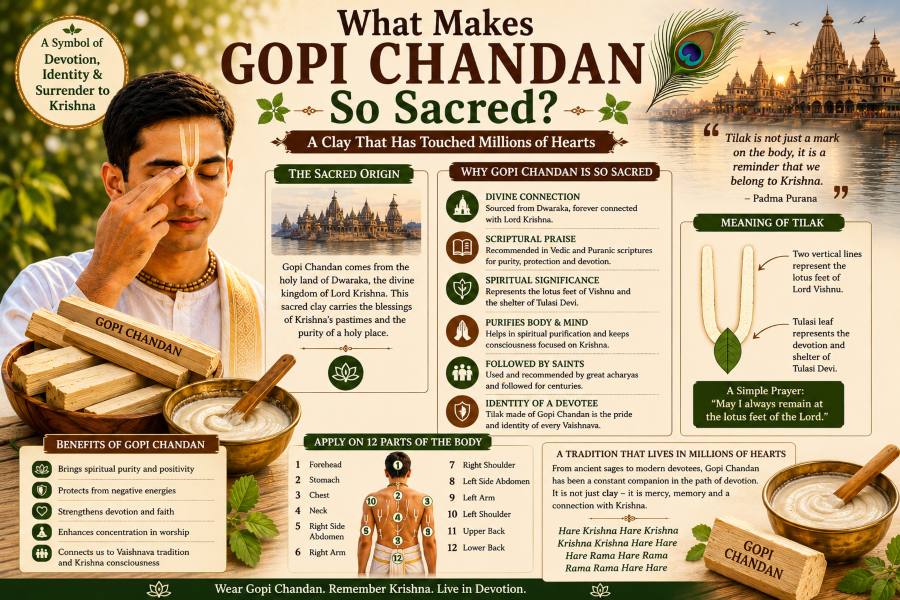
What Makes Gopi Chandan So Sacred? A Clay That Has Touched Millions of Hearts
Have you ever wondered how a simple piece of clay became one of the most cherished spiritual symbols in the Vaishnava tradition?
Walk into a temple in India, Europe, America, Africa, or Australia, and you will notice something remarkable. Devotees from completely different cultures, backgrounds, and languages often wear the same sacred marking on their foreheads. That marking is made from Gopi Chandan, a humble clay that has inspired devotion for centuries and continues to touch the hearts of millions around the world.
At first glance, it seems almost impossible. How can ordinary clay create such a deep emotional and spiritual connection?
The answer lies in a story that combines sacred history, devotion, symbolism, tradition, and personal transformation. For countless devotees, Gopi Chandan is not merely a ritual item. It is a daily reminder of Krishna, a symbol of surrender, and a connection to a spiritual heritage that stretches back thousands of years.
Those seeking authentic devotional products often turn to ISKCON Mayapur Online Store, where traditional Vaishnava items, including Gopi Chandan, are made available to devotees worldwide.
Let’s explore why this sacred clay continues to hold such a special place in the hearts of Vaishnavas everywhere.
More Than Clay: Looking Beyond the Physical Material
If someone unfamiliar with Vaishnava traditions sees Gopi Chandan for the first time, they might ask a reasonable question:
“What makes this clay different from any other clay?”
From a purely physical perspective, it may seem similar to other natural earth materials.
Yet spirituality often assigns value differently than the material world.
A family heirloom may be worth very little financially, but priceless emotionally.
A handwritten letter may have no market value, yet become someone’s most treasured possession.
Why?
Because meaning matters.
Connection matters.
Relationship matters.
The sacredness of Gopi Chandan comes from these deeper dimensions rather than from its physical characteristics alone.
For devotees, Gopi Chandan is not simply earth.
It is sacred earth connected to Krishna.
And that connection changes everything.
The Sacred Land Behind the Sacred Clay
To understand the importance of Gopi Chandan, we must first understand where it comes from.
Traditional Vaishnava teachings associate Gopi Chandan with the holy region of Dwaraka, the divine city where Lord Krishna performed many of His royal pastimes.
Dwaraka occupies a unique position within Hindu spiritual history.
For devotees, it is not merely an ancient city mentioned in scripture.
It is a sacred place touched directly by the presence of Krishna.
Sacred places hold tremendous importance in bhakti traditions because they preserve memories of divine activities.
Pilgrims travel thousands of miles simply to visit these holy locations.
They walk the same paths.
They offer prayers in the same places.
They seek spiritual inspiration from the atmosphere itself.
Gopi Chandan carries a connection to that sacred geography.
Each piece serves as a reminder of Krishna’s presence and pastimes.
Why Millions Feel Emotionally Connected to Gopi Chandan
There is something fascinating about devotional life.
Many spiritual practices appear simple on the surface but carry profound emotional significance.
Consider what happens when a devotee applies Gopi Chandan.
The process may take only a few minutes.
Water is added.
The clay becomes smooth.
Tilak is applied.
A prayer is offered.
The action itself is simple.
The meaning behind it is immense.
For many devotees, that moment creates a sense of connection with:
- Krishna
- Spiritual teachers
- Sacred traditions
- Fellow devotees
- Their own spiritual identity
Repeated daily over years, this practice becomes deeply woven into a person’s life.
It is no longer just a ritual.
It becomes part of who they are.
The Story Hidden in the Tilak Mark
One reason Gopi Chandan touches so many hearts is because of the powerful symbolism it carries.
The traditional Vaishnava tilak is not random decoration.
Every element has meaning.
The two vertical lines represent the lotus feet of Lord Vishnu.
The leaf-shaped marking at the base represents Tulasi Devi, one of Krishna’s most beloved devotees.
Together, the symbol expresses a beautiful spiritual aspiration:
“May I always remain sheltered at the lotus feet of the Lord.”
This transforms the application of Gopi Chandan into a prayer.
The devotee is not merely drawing lines on the forehead.
They are expressing surrender and devotion through a sacred symbol.
Why Simplicity Often Carries the Deepest Meaning
One of the most beautiful aspects of Gopi Chandan is its simplicity.
It is not expensive.
It is not luxurious.
It does not impress people through wealth or status.
Yet generations of saints have cherished it.
This reveals an important principle found throughout bhakti traditions.
Spiritual value often comes from consciousness rather than material cost.
Krishna is pleased by devotion.
Not extravagance.
A small offering given with sincerity carries greater value than a grand gesture performed without love.
Gopi Chandan embodies that principle perfectly.
A simple clay becomes sacred because of the devotion associated with it.
Understanding Purity Through a Vaishnava Lens
When Vaishnavas describe Gopi Chandan as pure, they are speaking about more than physical cleanliness.
Modern culture usually defines purity through material standards:
- Clean ingredients
- Safe materials
- Freedom from contamination
These considerations matter.
Yet Vaishnava philosophy introduces another dimension.
Spiritual purity refers to consciousness.
A pure object helps direct the mind toward God.
A pure practice strengthens remembrance.
A pure activity encourages devotion.
This is why Gopi Chandan receives such respect.
Its purpose is to help devotees remember Krishna throughout daily life.
That role gives it spiritual significance far beyond its physical form.
The Daily Practice That Changes Perspective
Many spiritual transformations happen quietly.
They do not arrive through dramatic experiences.
They emerge through consistent habits.
Applying Gopi Chandan is one of those habits.
Every morning, devotees pause before beginning the day.
For a brief moment, priorities become clear.
Work matters.
Responsibilities matter.
Family matters.
Yet above all these things stands one’s relationship with Krishna.
This daily reminder creates a subtle but powerful shift in perspective.
Over time, it influences decisions, attitudes, and behavior.
That influence explains why devotees continue the practice year after year.
Why Saints Kept Recommending Gopi Chandan
Throughout Vaishnava history, great acharyas repeatedly encouraged devotees to wear tilak made from sacred clay.
This consistency is significant.
Spiritual traditions preserve practices that provide genuine value.
When saints from different generations recommend the same practice, it suggests something important.
They understood that external reminders support internal growth.
Human beings forget.
The mind becomes distracted.
Sacred symbols help bring attention back to what matters most.
Gopi Chandan functions as one of those reminders.
Its simplicity makes it accessible.
Its symbolism makes it meaningful.
Its daily use makes it effective.
A Mark That Connects Generations
Imagine a devotee applying Gopi Chandan today.
Now imagine another devotee doing the same thing five hundred years ago.
The ritual remains remarkably similar.
The prayers remain similar.
The intention remains similar.
That continuity creates a powerful connection between generations.
Modern devotees do not feel isolated.
They become part of an ongoing spiritual tradition.
The same clay.
The same symbols.
The same purpose.
This sense of belonging contributes greatly to the emotional power of Gopi Chandan.
Why Gopi Chandan Creates a Sense of Identity
Every community has symbols that express identity.
Athletes wear team colors.
Nations fly flags.
Organizations display logos.
Vaishnavas wear tilak.
The difference is that tilak points toward a spiritual identity rather than a social one.
It reminds devotees:
- I belong to Krishna.
- I am part of a devotional tradition.
- My life has spiritual purpose.
- My actions should reflect my values.
Identity shapes behavior.
People naturally act according to how they see themselves.
Gopi Chandan reinforces a devotional identity each day.
The Surprising Psychology Behind Sacred Symbols
Modern psychology has discovered something religious traditions understood long ago.
Symbols influence behavior.
Visible reminders affect decisions.
Meaningful rituals shape habits.
When devotees wear Gopi Chandan, they carry a visible reminder of their spiritual commitments.
This can encourage:
- Greater mindfulness
- Improved self-discipline
- Consistent spiritual practice
- Stronger connection to values
The clay itself does not magically transform anyone.
The transformation comes through repeated remembrance and intentional living.
Why Gopi Chandan Feels Personal to Devotees
Ask ten devotees what Gopi Chandan means to them.
You may receive ten different answers.
Some associate it with childhood memories.
Others remember their spiritual teacher.
Some connect it with temple worship.
Others think about Krishna’s pastimes.
This personal dimension helps explain why the clay touches so many hearts.
It becomes intertwined with meaningful experiences.
Over time, it represents far more than a religious object.
It becomes a companion on the spiritual journey.
The Connection Between Humility and Sacred Clay
Humility occupies a central place within Vaishnava teachings.
Interestingly, Gopi Chandan supports that quality in subtle ways.
The tilak reminds devotees that they are servants of God.
This perspective differs dramatically from the ego-centered mindset often encouraged by modern culture.
Instead of asking:
“What can the world do for me?”
The devotee learns to ask:
“How can I serve Krishna?”
This shift in thinking influences every aspect of life.
The humble clay becomes a daily reminder of that attitude.
Why Gopi Chandan Remains Relevant in Modern Times
Technology has transformed nearly every aspect of human life.
Communication changed.
Transportation changed.
Entertainment changed.
Yet Gopi Chandan continues to be used by devotees around the world.
Why has it endured?
Because the human need for spiritual remembrance has not changed.
People still struggle with distraction.
People still seek meaning.
People still search for identity and purpose.
Gopi Chandan addresses these timeless needs through a simple but effective practice.
Its relevance comes from the fact that human nature remains remarkably consistent across generations.
The Twelve Tilak Marks and Complete Dedication
Many devotees apply Gopi Chandan not only to the forehead but also to twelve parts of the body.
Each location corresponds to a sacred name of Lord Vishnu.
The symbolism is beautiful.
The body becomes a temple.
The devotee dedicates every aspect of life to divine service.
This practice reinforces an important teaching:
Spirituality should not remain confined to a few minutes of worship.
It should extend into every action throughout the day.
The twelve tilak marks express that aspiration visually and practically.
A Sacred Tradition That Continues to Inspire
Some traditions survive because people feel obligated to preserve them.
Others survive because they continue to inspire.
Gopi Chandan belongs to the second category.
Its enduring popularity comes from the genuine spiritual value devotees experience through its use.
Generation after generation continues the practice because it helps maintain a living connection with Krishna.
That connection remains as meaningful today as it was centuries ago.
Why Gopi Chandan Has Touched Millions of Hearts
At its core, the sacredness of Gopi Chandan comes down to relationship.
Relationship with Krishna.
Relationship with sacred places.
Relationship with spiritual teachers.
Relationship with a devotional community.
Relationship with one’s own higher purpose.
The clay serves as a physical reminder of these relationships.
That reminder creates emotional resonance.
It creates meaning.
It creates devotion.
And that is why millions of hearts have been touched by something as simple as sacred clay.
Final Thoughts
The story of Gopi Chandan is not really about clay.
It is about remembrance.
It is about identity.
It is about devotion expressed through daily practice.
Its sacredness comes from centuries of spiritual tradition, its connection to Krishna’s holy pastimes, and its ability to help devotees maintain Krishna consciousness throughout their lives.
A small piece of clay may seem insignificant from a material perspective.
Yet when infused with devotion, history, symbolism, and spiritual purpose, it becomes something extraordinary.
That is the real reason Gopi Chandan continues to inspire millions of devotees around the world and remains one of the most beloved symbols of the Vaishnava tradition.


