

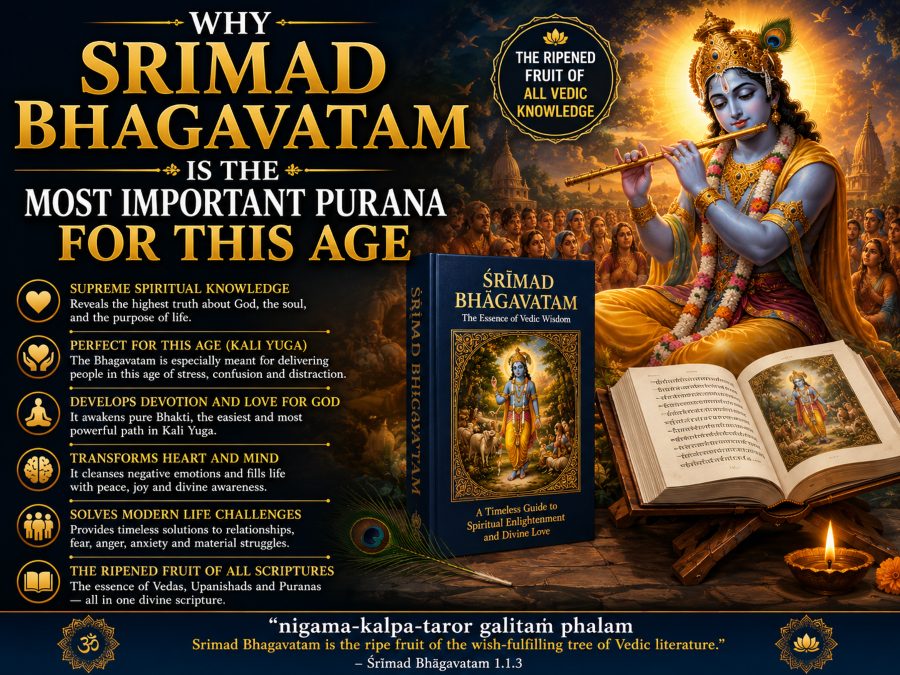
Why Srimad Bhagavatam is the Most Important Purana for This Age
There are eighteen major Puranas in the Vedic literary tradition. Each one is vast. Each one is sacred. Each one carries philosophical depth that could occupy a serious student for a lifetime. Yet the tradition itself — through its sages, its commentators, and its own internal testimony — has always pointed to one Purana above all others as the most essential, the most complete, and the most relevant scripture for the present age of human civilization.
That Purana is the Srimad Bhagavatam.
For anyone beginning to explore this claim, the Mayapur Store Srimad Bhagavatam collection offers an excellent starting point — a curated selection of authentic editions that carry the full philosophical weight and devotional depth this scripture demands. But before you invest in the text, it helps to understand why this particular Purana carries such extraordinary weight — not just as a matter of tradition, but as a living, breathing answer to the specific spiritual crises of our time.
The Age We Are Living In — Kali Yuga
To understand why the Srimad Bhagavatam is uniquely suited for this age, you first need to understand the age itself. According to the Vedic understanding of time, human civilization moves through four great cyclical ages — yugas — each one characterized by progressively declining conditions of consciousness, morality, memory, and lifespan.
We are currently in Kali Yuga — the fourth and final age of the cycle, described in the Bhagavatam itself (Canto 12) with remarkable precision. Kali Yuga is characterized by:
- Short human lifespan and diminished physical and mental capacity
- Widespread materialism and the equation of wealth with human worth
- Religious hypocrisy — spiritual performance replacing genuine inner transformation
- Conflict, anxiety, and a pervasive sense of meaninglessness
- Erosion of family bonds, community trust, and social integrity
- Distraction as a cultural norm — the mind perpetually pulled outward
If this list sounds less like ancient prophecy and more like a description of contemporary life, that is precisely the point. The Bhagavatam was not describing a distant future civilization with detached scholarly interest. It was providing a diagnosis — and, more importantly, a prescription.
The prescription for Kali Yuga, stated explicitly in the Twelfth Canto of the Bhagavatam, is sankirtana — the congregational hearing and chanting of the names, glories, and stories of the Supreme. And the Srimad Bhagavatam is the supreme manual for exactly this practice.
What Sets the Srimad Bhagavatam Apart From All Other Puranas
It Is Vyasa’s Own Final Statement
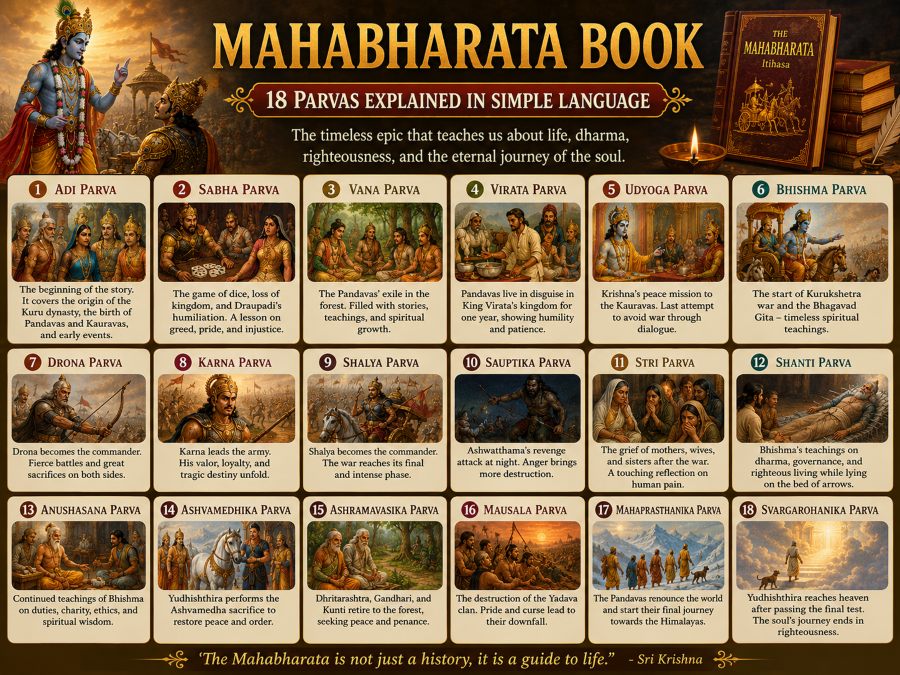
The sage Krishna Dvaipayana Vyasa is the most prolific author in human history. He compiled the four Vedas, authored the 108 Upanishads, wrote the massive Mahabharata (which includes the Bhagavad Gita), and composed all eighteen major Puranas — a body of work so vast it staggers the imagination.
Yet after completing all of this, the tradition records that Vyasa was not at peace. He felt a profound inner incompleteness, as though something essential had been left unsaid. His teacher Narada Muni identified the cause: in all his previous works, Vyasa had discussed dharma, cosmology, history, and metaphysics — but had not fully expressed the direct glorification of the Supreme Person, Bhagavan, with undiluted devotional focus.
The Srimad Bhagavatam was Vyasa’s response to this realization. It is not merely one of eighteen Puranas — it is his final, most mature, most deliberate work. The First Canto opens with this context explicitly, framing the entire scripture as the fruit of Vyasa’s deepest meditative realization.
When the most prolific spiritual author in history decides, at the end of his career, that everything he has written was incomplete without this — you pay attention.
Read Also:- 5,000-Year-Old Productivity Hack
The Self-Declared Crown of All Puranas
The Srimad Bhagavatam does not make modest claims about itself. In the Twelfth Canto (12.13.15), it declares:
“This Bhagavata Purana is as brilliant as the sun, and it has arisen just after the departure of Lord Krishna to His own abode, accompanied by religion, knowledge, and so forth. Persons who have lost their vision due to the dense darkness of ignorance in the age of Kali shall get light from this Purana.”
This self-description is not mere literary confidence. It is a statement of function — what the text is designed to do in precisely the historical moment we are now living in.
Every other major Purana has its own emphasis: the Vishnu Purana emphasizes theology, the Shiva Purana emphasizes the glories of Shiva, the Devi Bhagavatam centers the Divine Mother. The Srimad Bhagavatam synthesizes all of these streams while transcending any single sectarian focus. It is the Purana that sees the whole picture.
It Provides What Kali Yuga Specifically Needs
The Bhagavatam is not a scripture designed for an idealized, simplified world where people have abundant time, sharp minds, strong memory, and deep spiritual training. It was composed specifically for people who have none of those things — people exactly like us.
In Kali Yuga, the Bhagavatam teaches, elaborate rituals are impractical. Complex philosophical study requires more mental discipline than most people can sustain. Austerities demand a strength of body and will that this age does not produce reliably. All of these traditional paths — valuable in other ages — become inaccessible to the ordinary person of Kali Yuga.
What remains accessible? Hearing. Specifically, hearing the stories, names, and qualities of Bhagavan — the Supreme Person — with sincerity and attention. The Srimad Bhagavatam is constructed precisely to facilitate this: it is a scripture that transforms the listener through the act of listening itself, not through prior qualification or elaborate preparation.
King Parikshit — the original recipient of the Bhagavatam’s recitation — had only seven days to live. He had no time for years of study or gradual preparation. He sat, he heard, and in seven days he achieved liberation. The Bhagavatam’s own frame story is a demonstration of its accessibility to those in desperate circumstances — which is precisely the condition of the human soul in Kali Yuga.
The Philosophical Completeness of the Bhagavatam
It Contains All Four Goals of Life — and Transcends Them
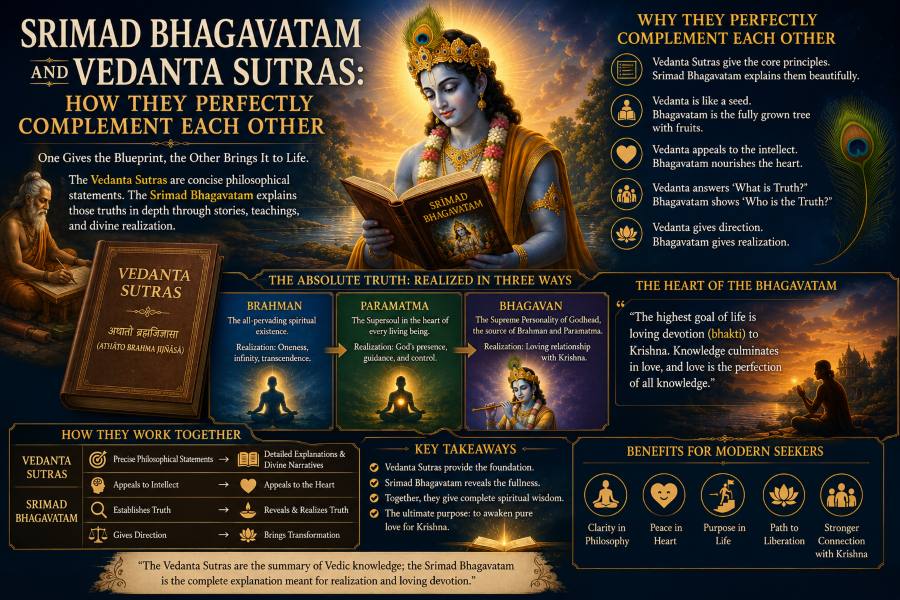
The traditional Vedic framework describes four legitimate human goals: dharma (righteousness), artha (prosperity), kama (desire fulfillment), and moksha (liberation). Most scriptures address one or two of these. The Bhagavatam addresses all four — and then, remarkably, points beyond all of them.
In the very first verse of the First Canto, the Bhagavatam introduces a fifth goal — parama dharma, the supreme purpose — which it identifies as bhakti (devotion) to Vishnu/Krishna, uncontaminated by any ulterior motive. This is not merely liberation from suffering or escape from the cycle of birth and death. It is a positive, active, relational state — the soul in its natural condition of love and service to the divine.
No other Purana articulates this fifth dimension with the same clarity, depth, and philosophical precision as the Srimad Bhagavatam.
It Addresses Every Level of the Seeker
The Bhagavatam does not speak to one type of reader. Its twelve Cantos address:
The intellectually inclined — The Second and Third Cantos contain some of the most sophisticated cosmological and metaphysical discussions in all of Sanskrit literature, including a detailed analysis of the elements of material creation, the nature of time, and the structure of the universe.
The devotionally inclined — The Tenth Canto, which narrates the life and pastimes of Lord Krishna from birth through his departure from Vrindavana, is considered the most exquisite devotional literature ever composed. It has inspired centuries of music, poetry, dance, sculpture, and painting across the Indian subcontinent.
The practically inclined — The Eleventh Canto contains the Uddhava Gita — Krishna’s final instructions to his dear friend Uddhava — which addresses practical spiritual living, ethics, the nature of the mind, and the path of devotion with extraordinary directness and applicability.
Those facing death and loss — The entire frame of the Bhagavatam — Parikshit facing death, Vyasa facing existential incompleteness — makes it the scripture most directly relevant to the human experiences of mortality, grief, and the search for meaning in the face of loss.
This range is unmatched in the Puranic literature.
The Bhagavatam and the Crisis of Modern Meaning
One of the defining features of our time is what philosophers and psychologists have called the meaning crisis — a widespread, culturally pervasive loss of the sense that life has inherent purpose, direction, or significance. The decline of traditional religious frameworks, the rise of materialist worldviews, and the acceleration of technology have together produced a civilization of extraordinary outward achievement and extraordinary inner emptiness.
The Srimad Bhagavatam addresses this crisis at its root. It does not simply offer comfort or reassurance. It provides a complete account of what a human life is for, what the self actually is, what the universe is made of and why, and what awaits the soul after death — all framed within a devotional relationship with the divine that gives every moment of ordinary life a dimension of transcendent significance.
Consider the famous declaration of the First Canto: dharmasya hy apavargyasya nartho ‘rthayopakalpate — the highest religion is that which leads to the complete liberation of the soul, not that which satisfies material desire. In a world where religion is frequently weaponized to serve economic and political interests, this declaration is as radical today as it was when first spoken.
The Bhagavatam does not accommodate spiritual compromise. It is not interested in making the seeker comfortable within a fundamentally misdirected life. It asks — and answers — the deepest questions, and it asks them without flinching.
Why Other Puranas, Though Important, Are Not Sufficient for This Age
This requires careful handling, because every major Purana is sacred and has its own essential role. The intention here is not dismissal but context.
The Vishnu Purana is theologically precise but relatively brief and does not provide the narrative richness and devotional warmth of the Bhagavatam. The Devi Bhagavatam is magnificent for the worship of the Divine Mother but does not address the full range of human spiritual need. The Shiva Purana is essential for devotees of Shiva but is not designed as a universal scripture for all types of seekers.
The Srimad Bhagavatam, by contrast, was composed with the specific intention of serving all categories of sincere seekers in the present age. Its scope is universal. Its tone ranges from intellectually rigorous to achingly devotional to practically instructive. And its central subject — the nature of Bhagavan and the soul’s relationship with Him — is the subject that Vedic tradition identifies as the ultimate answer to the ultimate question.
The Living Tradition — Why the Bhagavatam Still Transforms Lives
It would be easy to treat all of this as historical or academic interest — impressive ancient literature, philosophically sophisticated, but ultimately a relic of a different civilization. That would be a serious mistake.
Across the world today, there are thousands of study groups, saptaha (seven-day recitations), temple programs, online communities, and individual practitioners whose inner lives have been fundamentally transformed by sustained engagement with the Srimad Bhagavatam. The transformation is not metaphorical or vague — people report specific shifts in how they relate to fear, grief, anger, material desire, and the fundamental question of who they are.
The Bhagavatam’s power is not theoretical. It works. It has worked for thousands of years, in vastly different cultural contexts, for vastly different types of people. The consistency of its effect — purification of consciousness, deepening of compassion, growth of genuine spiritual awareness — is itself testimony to the unique potency of this scripture.
How to Approach the Srimad Bhagavatam in This Age
Given the nature of Kali Yuga — short attention spans, busy lives, fragmented minds — a few practical principles for approaching the Bhagavatam are worth stating clearly.
Start anywhere, but start. The Bhagavatam does not require you to begin at the First Canto and proceed sequentially. Many practitioners begin with the Tenth Canto (Krishna’s life), others with the Second Canto’s cosmology, others with specific stories that call to them. Entry points matter less than entry.
Hear it as much as possible. The Bhagavatam consistently emphasizes shravana — hearing — as the primary practice of this age. Audio recordings, kirtans based on Bhagavatam verses, and live recitations carry the scripture’s potency in ways that silent reading alone sometimes does not.
Study with commentary. The Bhagavatam without commentary is like a map without a legend. A qualified, lineage-based commentary — particularly one grounded in the Gaudiya Vaishnava tradition — unlocks dimensions of meaning that the text itself does not make explicit.
Be patient with your own resistance. The Bhagavatam is a large, complex, sometimes challenging text. There will be passages that confuse, sections that seem irrelevant, philosophical discussions that strain the mind. This is normal. The tradition promises that persistent engagement transforms the reader over time — not by the reader mastering the text, but by the text gradually mastering the reader.
Closing: A Scripture That Knows What Age It Was Written For
The Srimad Bhagavatam is, among many other things, a deeply self-aware scripture. It knows when it was composed and why. It knows the condition of the human being who will receive it — distracted, short-lived, spiritually undernourished, longing for something real beneath the noise of material life.
It was written for exactly the person reading these words.
The eighteen Puranas are all worthy of reverence. But among them, the Srimad Bhagavatam stands alone — not because tradition says so, but because its contents, its depth, its range, its accessibility, and its direct applicability to the specific suffering of this specific age make it uniquely indispensable.
In a world that has more information than it knows what to do with, the Bhagavatam offers something rarer: wisdom. Not information about the divine, but a living encounter with it — page by page, verse by verse, story by story.
This age needs it. You need it. Begin.
The light the Bhagavatam offers is not borrowed light. It is the source.