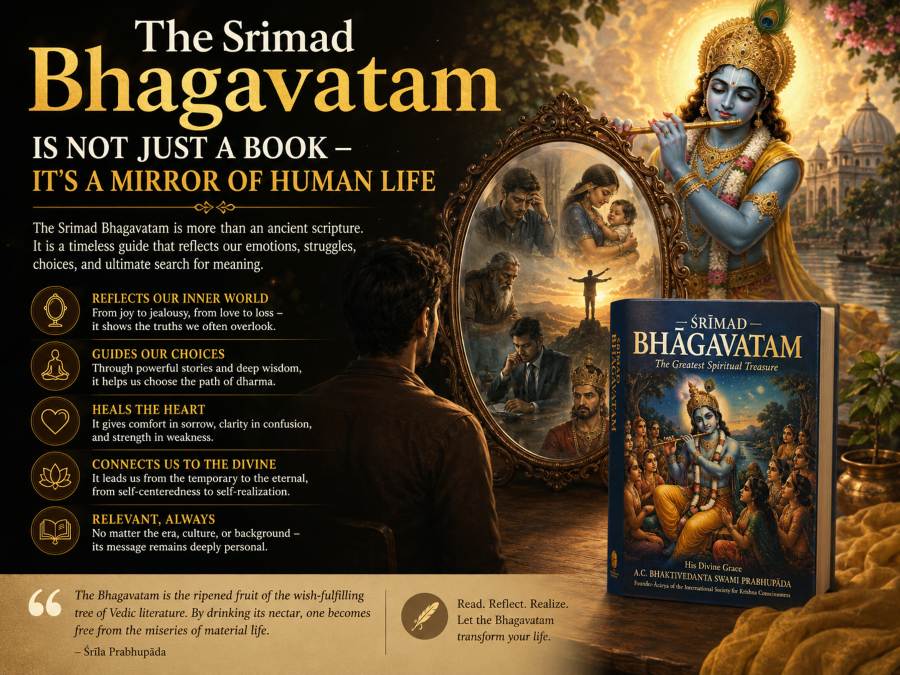




Are Srimad Bhagavatam and Bhagavata Purana the Same?
For many people beginning their journey into Vedic knowledge, one of the most common doubts is:
“Is Srimad Bhagavatam the same as the Bhagavata Purana?”
Because in the world of Hindu scriptures, multiple names, translations, and versions exist, new readers often get confused. Some people read “Srimad Bhagavatam,” some call it “Bhagavata Purana,” some say “Bhagavatam,” and others refer to it as “Sri Bhagavata.” This creates a question: Are these different books, or is it one scripture with many names?
To remove all confusion clearly, and to guide devotees properly, this article explains everything in detail—origins, names, structure, authorship, purpose, and how ISKCON (through BBT) presents this scripture. By the end, you will completely understand the distinction and the unity between these two names.
Same Scripture, Different Names – The Straight Answer
Yes.
Srimad Bhagavatam and Bhagavata Purana are the same scripture.
There is no difference between the two.
“Bhagavata Purana” is the traditional Sanskrit name found in ancient texts.
“Srimad Bhagavatam” is the devotional, respectful, glorified name used especially by Vaishnavas, sages, and spiritual teachers, including Srila Prabhupada and the entire Gaudiya Vaishnava tradition.
The original Sanskrit title is:
श्रीमद्भागवतम् (Śrīmad Bhāgavatam)
which literally translates to:
“The Beautiful, Divine, Auspicious Book about the Supreme Lord.”
The term “Purana” simply classifies it as one of the eighteen major Puranas, making its formal category name:
भगवत पुराण (Bhagavata Purāṇa).
So in essence:
Bhagavata Purana = Srimad Bhagavatam = Bhagavatam = The same scripture.
Why Two Names? The Difference in Usage
Although the scripture is the same, both names have slightly different contexts in which they are used.
“Bhagavata Purana” – The classical name
This name is often used in academic, historical, and traditional contexts.
Scholars, Indologists, and Vedic researchers prefer calling it the “Bhagavata Purana” because they classify scriptures according to their Purana categories.
“Srimad Bhagavatam” – The devotional name
This name is popular in the Vaishnava community, especially in ISKCON, Gaudiya Math, and the followers of Sri Chaitanya Mahaprabhu.
“Srimad” adds a layer of reverence, meaning “divine,” “holy,” or “glorious.”
Srila Prabhupada purposely chose ‘Srimad Bhagavatam’ because:
- it emphasizes devotion, not just history
- it carries spiritual mood
- it aligns with Gaudiya Vaishnava tradition
- it highlights the scripture’s purity and transcendental nature
Within ISKCON, the name Srimad Bhagavatam is standard and universal.
READ ALSO:- Gita Daan on Akshaya Tritiya
The Common Confusion: Why People Think They Are Different
Many people become confused due to the following reasons:
Different Cover Titles
Some publishers print “Bhagavata Purana” on the cover, while others print “Srimad Bhagavatam.”
This makes newcomers think they are separate books.
Regional Language Variations
In Hindi: Bhagwat Puran
In Bengali: Bhagabat Puran
In Tamil: Bhagavata Puranam
In English: Srimad Bhagavatam
Different languages sometimes give the illusion of different scriptures.
Multiple Versions in the Market
Different authors and publishing houses present summaries, shortened versions, or simplified stories titled “Bhagwat Puran.”
These are not equal to the full Srimad Bhagavatam with Sanskrit verses and purports.
ISKCON’s 18-volume edition
Srila Prabhupada’s Srimad Bhagavatam is a 12-canto, multi-volume set exceeding 10,000+ pages.
People sometimes think “Bhagavata Purana” refers to a smaller, simpler version.
Origin of the Scripture: Same Source Text
Both names refer to the same scripture written by:
Śrīla Vyāsadeva,
the literary incarnation of Lord Krishna.
After writing Mahabharata and the Vedas, Vyasa still felt incomplete. His guru, Narada Muni, instructed him to write a scripture dedicated purely to Bhakti (devotional service) and the pastimes of the Supreme Lord.
Thus was born:
The Bhagavata Purana — the topmost Purana, completely centered on Krishna.
Chaitanya Mahaprabhu himself declared that Srimad Bhagavatam is the natural commentary on Vedanta-sutra, giving it divine authority.
Structure: Both Names Refer to One 12-Canto Scripture
Whether you call it Srimad Bhagavatam or Bhagavata Purana, the structure is identical:
- 12 Cantos (Skandhas)
- 335 Chapters
- 18,000 Verses
- Cosmology, Creation, Incarnations, Devotees, Krishna-lila, Philosophy
- Direct glorification of Krishna as the Supreme Personality of Godhead
- Teachings on Bhakti, Dharma, Karma, and Moksha
- Narrations of great devotees: Prahlada, Dhruva, Ambarisha, Bharata, Gajendra, Rishabhadeva
- The entire life and pastimes of Krishna (Canto 10)
Every version, translation, or edition of this scripture—if genuine—contains these 12 cantos.
Purpose: Why This Scripture Exists
(Same Goal, Same Message)**
Both names point to a scripture whose purpose is singular and profound:
To awaken pure love of God (Krishna) in the hearts of living beings.
Unlike other Puranas that discuss mixed topics, the Bhagavata Purana focuses entirely on:
- Krishna’s supremacy
- Devotional service (bhakti)
- The lives of pure devotees
- The soul’s relationship with God
- Liberation through hearing and chanting
Srila Prabhupada explains that Srimad Bhagavatam is the ripe fruit of the Vedic tree, meaning it is the most essential spiritual teaching.
ISKCON’s Contribution: Why “Srimad Bhagavatam” Became More Popular Worldwide
Though Bhagavata Purana is an ancient scripture, the name Srimad Bhagavatam became globally known mainly due to ISKCON and Srila Prabhupada.
Srila Prabhupada’s translation and purports
He translated the entire scripture into English, with detailed purports based on the teachings of:
- Sri Chaitanya Mahaprabhu
- Six Goswamis of Vrindavan
- Srila Bhaktivinoda Thakura
- Srila Bhaktisiddhanta Sarasvati Thakura
These purports transformed the scripture from a classical text into a global guidebook for spiritual life.
18-Volume BBT Edition
ISKCON’s BBT publishes Srimad Bhagavatam in:
18 hardbound volumes, fully authorized, with original Sanskrit, word-for-word meanings, translations, and deeply philosophical purports.
This became the standard edition for devotees.
Thus, the name “Srimad Bhagavatam” spread worldwide through:
- Temple classes
- Bhakti courses
- YouTube lectures
- Daily reading programs
- House programs
- International sankirtan distribution
Why Devotees Prefer Saying “Srimad Bhagavatam” Instead of “Bhagavata Purana”
Even though both are same, devotees prefer “Srimad Bhagavatam” because:
- it feels personal
- it reflects the devotional mood
- it highlights the transcendental nature
- it honors Krishna and the sages
- it aligns with Gaudiya Vaishnava tradition
“Bhagavata Purana” sounds academic.
“Srimad Bhagavatam” sounds devotional and spiritual.
Is There Any Difference in Content?
No difference at all.
The content is identical—only the name changes depending on context.
However, there is a difference between:
- Original Sanskrit scripture and
- Simplified storybooks titled “Bhagwat Puran”
Many publishers produce short story versions of the Bhagavata Purana. These are not complete or authoritative.
The complete scripture is available only in the full 12-canto edition.
Which One Should You Read?
For devotion, understanding, and spiritual growth:
Always read Srimad Bhagavatam (BBT edition).
This version includes:
- Original Sanskrit
- Roman transliteration
- Word-for-word meanings
- English translations
- Purports by Srila Prabhupada
These purports are nectar—practical, insightful, compassionate, and transformative.
Short story versions cannot replace this.
What Does Srila Prabhupada Say?
Srila Prabhupada consistently used the name Srimad Bhagavatam, not “Bhagavata Purana.”
He emphasized that it is the natural commentary on Vedanta-sutra and the most important scripture for Kali-yuga.
He declared:
“Srimad Bhagavatam is the spotless Purana.”
and
“One who reads Srimad Bhagavatam daily makes steady progress toward pure devotion.”
His teachings removed all confusion:
Both names refer to the same scripture, but Srimad Bhagavatam is the exalted, devotional way to refer to it.
Final Conclusion: One Scripture, Two Names
To summarize clearly:
- Srimad Bhagavatam = Bhagavata Purana = Bhagavatam = Same scripture
- “Bhagavata Purana” is the classical category name
- “Srimad Bhagavatam” is the devotional and spiritually rich name
- Content, cantos, verses, and purpose are identical
- ISKCON universally uses the name Srimad Bhagavatam because of devotional mood
- Both refer to the 12-canto, 18,000-verse Purana dedicated to Krishna
There is no difference in meaning—only difference is in tone and tradition.