


Krishna Book: The Ultimate Guide to Lord Krishna’s Life and Teachings
The Krishna Book is one of the most loved devotional works for readers who want to understand Lord Krishna in a deeper and more meaningful way. It is not just a retelling of sacred events from an ancient tradition. It is a spiritually rich guide that reveals Krishna’s life, His divine personality, His teachings, His relationships, and the deeper truths hidden within His pastimes. For many readers, this book becomes more than a source of information. It becomes an entry point into bhakti, reflection, and a more personal understanding of the Supreme Lord. Those searching for authentic devotional editions and Krishna-centered spiritual literature often turn to ISKCON Mayapur Store while exploring trusted sources for Vaishnava books.
What makes the Krishna Book so remarkable is its ability to speak to readers at many levels. A beginner may first approach it through curiosity about Krishna’s childhood stories, His miracles, or His adventures in Vrindavan. A serious spiritual reader may be drawn to its deeper theological meaning and devotional insights. In both cases, the book offers something far greater than expected. It gradually reveals why Krishna is worshiped as the Supreme Personality of Godhead and why His life remains eternally relevant for anyone seeking spiritual truth, love, and purpose.
What Is the Krishna Book?
The Krishna Book is a devotional presentation of the divine pastimes of Lord Krishna, mainly drawn from the Tenth Canto of the Srimad Bhagavatam. It brings these sacred narratives into a form that is vivid, approachable, and spiritually engaging for modern readers. Yet while it is accessible, it is never superficial. The book preserves the devotional essence and theological richness of the original tradition while making Krishna’s life easier to enter through storytelling and explanation.
This is one of the reasons the Krishna Book holds such an important place in bhakti literature. Not everyone begins their spiritual journey with direct study of Sanskrit scripture. Many need a bridge that allows them to approach Krishna through beauty, feeling, and story while still receiving authentic philosophy. This book serves exactly that role. It introduces readers to Krishna not merely as a figure of history or mythology, but as the eternal Supreme Lord whose pastimes are spiritually real and deeply transformative.
The text also carries extraordinary emotional depth. A child may enjoy its stories, a thoughtful adult may reflect on its meaning, and a devotee may return to it again and again for remembrance and nourishment. It works at all these levels because Krishna’s life itself is inexhaustible.
Why Lord Krishna’s Life Is Spiritually Unique
Lord Krishna’s life is not understood in devotional theology as an ordinary biography. His appearance, actions, and relationships are all divine pastimes, meaning they are eternal, purposeful, and spiritually complete. This makes His life fundamentally different from the lives of great leaders, saints, or mystics. Krishna does not simply teach spiritual truth. He is the source of spiritual truth.
That is why the Krishna Book is so powerful. It does not just tell the story of a remarkable person. It reveals what happens when the Absolute Truth appears in fully personal form. Through Krishna’s life, readers see that God is not only powerful and all-knowing, but also beautiful, loving, playful, intimate, and full of reciprocal affection.
This has deep importance for spiritual readers today. Many people grow up with vague ideas of God as distant, abstract, or difficult to relate to. The Krishna Book offers a radically fuller picture. Krishna is the Supreme Person who can be remembered, loved, served, and approached through devotion. He is not reduced by personality; He is perfected by it.
His life is spiritually unique because it holds together two truths that seem impossible to combine. He is utterly supreme, yet completely approachable. He performs unimaginable miracles, yet plays like a village child. He is worshiped by great gods and sages, yet allows Himself to be loved by simple devotees in intimate ways. This balance of majesty and sweetness is one of the deepest attractions of Krishna.
The Beauty of Krishna’s Childhood Pastimes
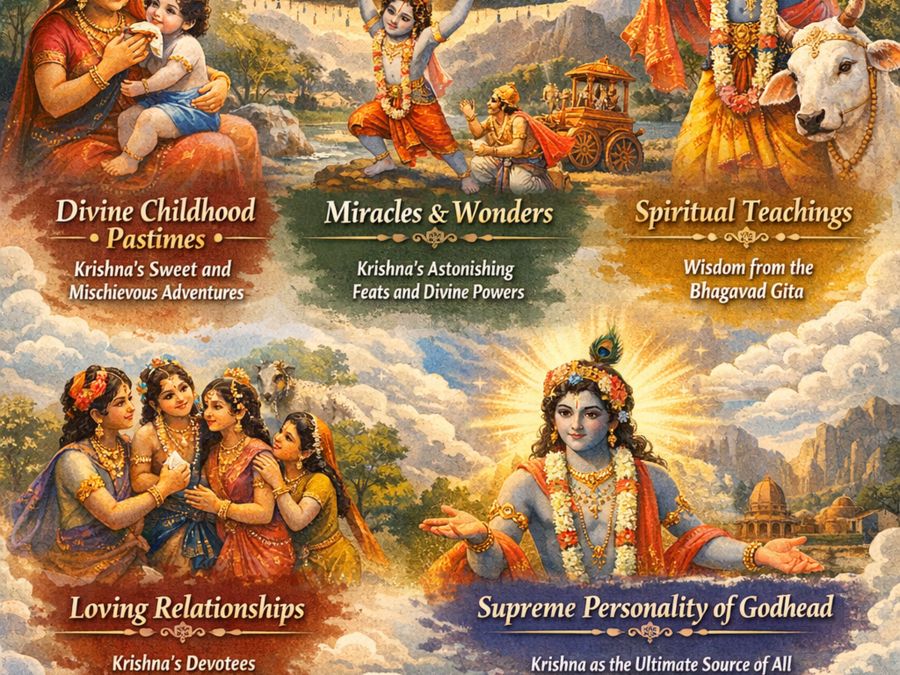
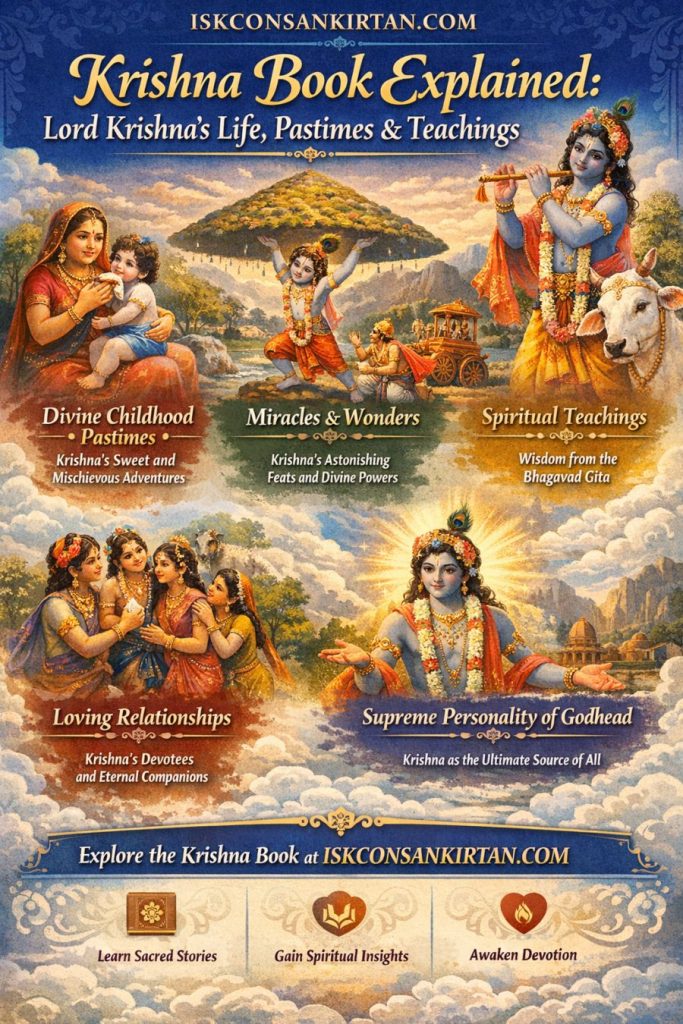
One of the most beloved dimensions of the Krishna Book is its narration of Krishna’s childhood in Gokula and Vrindavan. These pastimes are filled with sweetness, tenderness, and wonder. Krishna appears as a mischievous, enchanting child who steals butter, delights His mother, plays with His friends, and fills every home with joy. Yet these scenes are not just charming stories. They reveal profound truths about the nature of divine love.
Krishna’s childhood demonstrates that the Supreme Lord allows Himself to be loved intimately. He is not accessible only through fear or formal reverence. He becomes the darling son of Mother Yashoda and Nanda Maharaj, receiving affection in the most personal form. In bhakti theology, this is a stunning revelation. God is not less than personal. He is supremely personal.
Even Krishna’s playful mischief carries spiritual meaning. Devotional teachers often explain that His butter stealing symbolizes how He steals the essence of the heart once it has been softened by love. His laughter, His charm, and His irresistible presence are not ordinary childhood traits. They are manifestations of divine sweetness.
At the same time, these pastimes never allow the reader to forget Krishna’s supreme power. Even while appearing as a child, He destroys dangerous demons and protects the residents of Vrindavan. This union of innocence and supremacy is one of the defining features of His life.
Krishna’s Teachings Hidden in His Actions
The Krishna Book reveals that Krishna does not teach only through spoken philosophy. He teaches through action, relationship, and divine example. His life itself becomes a form of instruction, and this is one reason the book remains so transformative.
When Krishna protects His devotees, He teaches that surrender to Him is meaningful and real. When He lifts Govardhan Hill, He teaches that devotion is superior to prideful ritualism and that He alone is the true shelter of all beings. When He plays with His friends or responds to the love of His devotees, He teaches that spiritual life is not just duty. It is relationship.
This way of teaching is especially powerful because it enters the heart more deeply than abstract instruction alone. Readers do not simply learn doctrines. They witness truth unfolding in vivid, memorable scenes. This makes the lessons easier to internalize and harder to forget.
For modern readers, this is especially valuable. Many people feel disconnected from purely theoretical religion. They long for spiritual wisdom that feels alive, embodied, and emotionally real. Krishna’s life offers exactly that. His actions reveal what love, surrender, protection, humility, and devotion look like in living form.
The Spiritual Power of Krishna’s Miracles
Krishna’s miracles are among the most striking features of the Krishna Book. He subdues mighty demons, lifts Govardhan Hill, protects entire communities, and displays unimaginable strength and intelligence. Yet these miraculous acts are not included just to create wonder. They reveal deep spiritual truths.
First, they establish Krishna’s identity as the Supreme Personality of Godhead. He is not a mystic or extraordinary human being. He is the source of all energies. Nature does not control Him. He is the origin of nature itself.
Second, Krishna’s miracles consistently reveal His protective love. He uses power not for ego or display, but to care for His devotees. This is what makes His power spiritually beautiful. It is always connected with compassion.
Third, many miracles carry symbolic lessons. Govardhan-lila, for example, is not only a display of divine strength. It is also a lesson in surrender, the rejection of pride, and the superiority of direct devotion to Krishna. The miracle becomes a theological revelation.
For modern readers, these pastimes do something important. They challenge a worldview limited by material assumptions and remind the heart that divine reality is not bound by our narrow expectations. More importantly, they show that Krishna is a living shelter for those who turn toward Him.
The Devotees Around Krishna and Their Importance
Krishna’s life is never shown in isolation. One of the great strengths of the Krishna Book is its rich portrayal of the devotees around Him. These relationships are essential because they reveal how the soul is meant to relate to Krishna.
Mother Yashoda shows the beauty of parental love toward the Divine. The cowherd boys reveal the joy of friendship with God. The gopis reveal the highest intensity of loving absorption in Krishna. Each relationship discloses a different spiritual mood, and together they show that devotion is deeply personal.
This matters because the soul is not fulfilled merely by abstract knowledge. It is fulfilled by loving relationship. Krishna’s devotees reveal that the perfection of life lies in offering oneself fully to Him. Their love is not mixed with selfish ambition or worldly calculation. It is centered on Krishna’s happiness.
For a modern audience, this is deeply refreshing. In a world where relationships are often transactional and unstable, the Krishna Book reveals a model of love rooted in devotion, sincerity, and spiritual completeness. It teaches that the purest form of love is love connected to Krishna.
How the Krishna Book Reveals the Supreme Personality of Godhead
One of the deepest contributions of the Krishna Book is that it reveals Krishna not merely as a divine figure, but as the original Supreme Personality of Godhead. This means He is the source of all incarnations, all energies, and all forms of divine manifestation. He possesses personality in its highest, purest, and most complete form.
This teaching is spiritually significant because many people today think of God in abstract or impersonal terms. The Krishna Book offers a profoundly different vision. It shows that ultimate reality is personal, relational, all-attractive, and full of qualities. Krishna has form, but that form is eternal and transcendental. He has relationships, but they are absolute and spiritually perfect.
This changes everything about devotion. If Krishna is the Supreme Personality of Godhead, then hearing about Him, remembering Him, serving Him, and loving Him become direct participation in the highest truth. Bhakti is not symbolic sentiment. It is the soul’s eternal function.
The beauty of the book is that it teaches this not just through formal doctrine, but through Krishna’s life itself. Readers come to understand His supreme identity by seeing how His sweetness, power, beauty, wisdom, and love all exist together in absolute fullness.
Why the Krishna Book Matters in Modern Life
The Krishna Book remains deeply relevant because modern life often leaves people inwardly tired and spiritually scattered. There is endless information, but very little wisdom that nourishes the heart. There is constant activity, but not much peace. In such a world, Krishna’s life and teachings offer a different center.
The book teaches that real happiness is not found in material success alone. It shows that the soul longs for divine relationship. It reveals that love becomes purified when centered on Krishna, and that remembrance of Him can transform ordinary life into spiritual life.
It also restores beauty to spirituality. Modern existence can feel harsh, rushed, and mechanical. Krishna’s pastimes reintroduce sweetness, tenderness, wonder, playfulness, and sacred intimacy. They remind readers that spiritual truth is not only something to think about. It is something to love.
For seekers who feel dissatisfied with shallow spirituality, the Krishna Book offers depth. For readers tired of dry theology, it offers warmth and feeling. For devotees seeking to deepen remembrance, it offers an enduring source of nourishment. That wide relevance is one reason it has remained cherished across generations.
What Readers Gain from the Krishna Book
Different readers receive different gifts from the Krishna Book, but one benefit is almost universal: inner transformation. A new reader may gain a first real understanding of who Krishna is. A thoughtful seeker may gain clarity about the personal nature of God. A devotee may gain renewed attraction to hearing and remembrance.
More deeply, the book helps purify consciousness. Hearing about Krishna repeatedly softens the heart, weakens material distraction, and creates a natural taste for devotion. In this way, reading the Krishna Book becomes more than study. It becomes spiritual practice.
It also helps readers see that devotion is not blind emotion. It is intelligent, relational, and spiritually grounded. Krishna’s life reveals how philosophy, beauty, discipline, and love all meet in bhakti. That wholeness is one of the reasons the book remains so spiritually powerful.
Conclusion
The Krishna Book truly deserves to be called an ultimate guide to Lord Krishna’s life and teachings. It introduces readers to His childhood sweetness, His miracles, His divine relationships, His spiritual lessons, and His identity as the Supreme Personality of Godhead. More than that, it reveals why His life remains eternally relevant for anyone seeking truth, devotion, and inner transformation.
Its greatness lies in its balance. It is accessible without being shallow, devotional without being sentimental, and theological without becoming dry. It invites the reader not only to know about Krishna, but to remember Him, love Him, and gradually center life around Him.
For anyone wanting a spiritually rich and meaningful understanding of Lord Krishna, the Krishna Book remains one of the finest devotional works available. It does not simply narrate sacred events. It opens a door into the heart of bhakti.