




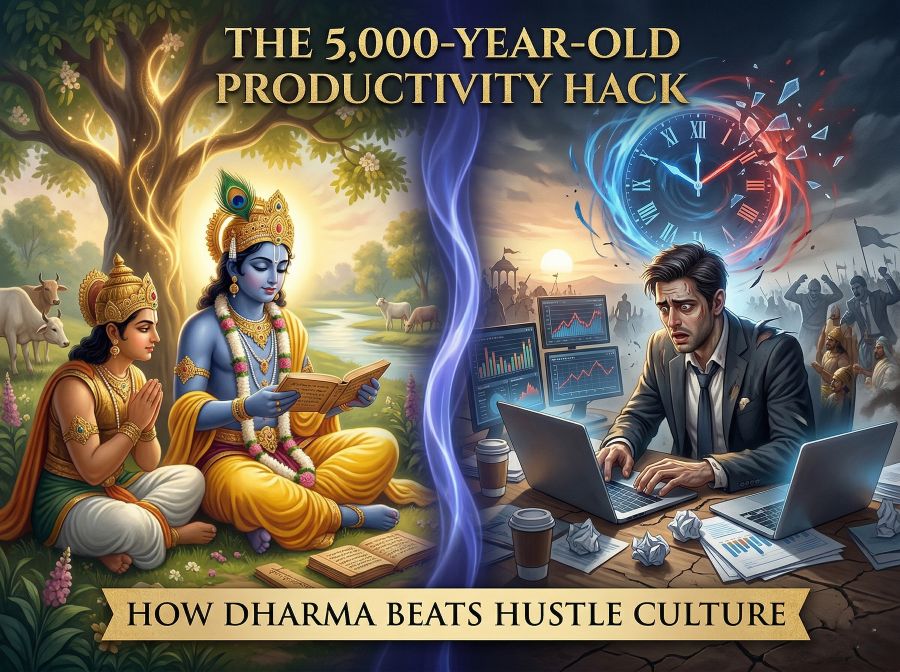
The 5,000-Year-Old Productivity Hack: How Dharma Beats Hustle Culture
In today’s fast-paced digital economy, productivity has become almost synonymous with relentless work. The rise of hustle culture glorifies long hours, constant busyness, and the idea that success comes only to those who never stop grinding. Social media feeds are flooded with “rise and grind” mantras, productivity hacks, and morning routines designed to squeeze every ounce of output from our day.
Yet, despite all this effort, a growing number of people feel exhausted, disconnected, and unfulfilled. Burnout is no longer an exception—it is becoming the norm. People are achieving more but feeling less satisfied. This paradox raises a critical question: Is modern productivity fundamentally flawed?
Interestingly, ancient wisdom offers a powerful alternative. The concept of Dharma, rooted in 5,000-year-old Vedic philosophy, presents a radically different approach to productivity—one that emphasizes purpose, balance, and inner alignment rather than constant output.
This article explores how Dharma can serve as a timeless productivity framework—one that not only helps you achieve more but also feel deeply fulfilled while doing it.
What Is Dharma? A Timeless Framework for Purposeful Action
At its core, “dharma” refers to one’s natural duty, purpose, or the right way of living in alignment with universal principles. Unlike modern definitions of productivity that focus on external results, Dharma emphasizes internal alignment and meaningful action.
Dharma is not just about what you do—it’s about why and how you do it.
In ancient texts, dharma is described as the guiding principle that sustains harmony—within the individual and in the world. When you act according to your Dharma, your actions feel natural, energizing, and purposeful. When you act against it, even success can feel empty.
Key elements of dharma include
- Purpose-driven action rather than obligation-driven work
- Alignment with your nature instead of imitation
- Contribution over competition
- Sustainability over intensity
This perspective shifts productivity from a mechanical process into a deeply human and spiritual experience.
Read Also:- ISKCON Books: Deep Dive Into Krishna Consciousness
Hustle Culture: The Illusion of Endless Achievement
Hustle culture operates on a very different philosophy. It assumes that:
- More work equals more success
- Rest is a weakness
- Busy equals important
- External achievements define self-worth
While this approach can produce short-term results, it often leads to long-term consequences such as:
- Chronic stress and burnout
- Loss of creativity and clarity
- Emotional dissatisfaction
- Disconnection from personal values
The biggest flaw of hustle culture is that it treats humans like machines. It ignores the reality that energy, focus, and creativity are not infinite resources.
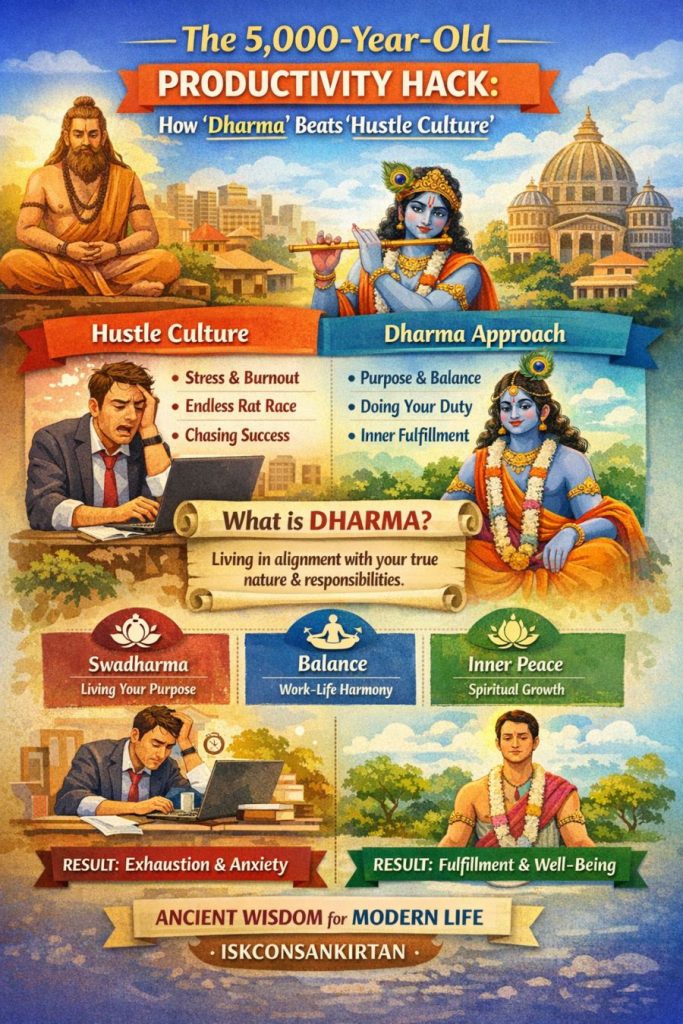
In contrast, Dharma recognizes that human beings function best when their actions are aligned with their inner nature and higher purpose.
Dharma vs Hustle: A Fundamental Shift in Productivity Philosophy
To understand why Dharma is a superior productivity model, it’s helpful to compare the two directly.
1. Output vs Alignment
Hustle culture prioritizes output at any cost. Dharma prioritizes alignment—ensuring that your actions are meaningful and sustainable.
2. External Validation vs Inner Fulfillment
Hustle culture seeks recognition, status, and results. Dharma focuses on fulfillment, contribution, and inner peace.
3. Quantity vs Quality
Hustle encourages doing more. Dharma encourages doing what truly matters—and doing it well.
4. Short-Term Gains vs Long-Term Balance
Hustle culture often sacrifices health and relationships for quick wins. Dharma emphasizes balance and long-term well-being.
This shift is not just philosophical—it has practical implications for how you structure your day, choose your goals, and define success.
The Science Behind Dharma: Why It Actually Works
Although Dharma originates from ancient philosophy, its principles are strongly supported by modern psychology and neuroscience.
1. Intrinsic Motivation
When you work in alignment with your purpose, you are driven by intrinsic motivation. Research shows that intrinsically motivated individuals are more productive, creative, and satisfied.
2. Flow State
Dharma naturally leads to a state of “flow”—a mental state where you are fully immersed in your work. This is where peak performance happens effortlessly.
3. Reduced Cognitive Load
When your actions align with your values, decision-making becomes easier. You spend less energy questioning yourself and more energy executing.
4. Sustainable Energy Management
Unlike hustle culture, which depletes energy, Dharma-based work replenishes it. You feel energized rather than drained.
In essence, Dharma is not just spiritually sound—it is biologically efficient.
How to Discover Your Dharma
One of the most common questions is, “How do I find my Dharma?”
While there is no one-size-fits-all answer, there are practical steps you can follow.
1. Identify What Comes Naturally to You
Your Dharma often lies in your natural strengths and inclinations. Ask yourself:
- What do I enjoy doing without external pressure?
- What activities make me lose track of time?
2. Observe What Feels Meaningful
Dharma is deeply connected to meaning. Notice what gives you a sense of purpose beyond money or recognition.
3. Reflect on Contribution
Your Dharma is not just about you—it’s about how you contribute to others. Ask:
- How can my skills serve others?
- What problems do I feel compelled to solve?
4. Listen to Inner Resistance
When something feels consistently forced or draining, it may be a sign that it is not aligned with your Dharma.
Discovering your Dharma is a process, not a one-time event. It evolves as you grow.
Applying Dharma to Daily Productivity
Understanding Dharma is one thing—applying it is another. Here’s how you can integrate it into your daily life.
1. Redefine Your To-Do List
Instead of listing tasks based on urgency alone, prioritize tasks that align with your purpose.
2. Focus on Deep Work
Dharma encourages focused, meaningful work rather than scattered multitasking. Dedicate time to high-impact activities.
3. Embrace Rhythms, Not Rigid Schedules
Work with your natural energy cycles. Some people are more productive in the morning, others at night.
4. Build Rest into Your System
Rest is not a reward—it is part of the process. Dharma recognizes that recovery enhances productivity.
5. Let Go of Comparison
Your Dharma is unique. Comparing your journey with others only creates distraction and dissatisfaction.
Why Dharma Leads to Long-Term Success
Success driven by hustle is often fragile—it depends on constant effort and external validation. Success driven by Dharma is stable and self-sustaining.
1. Consistency Without Burnout
When your work feels meaningful, you can sustain it over the long term.
2. Authentic Growth
You grow in a way that is true to yourself, rather than chasing trends or expectations.
3. Deeper Satisfaction
Even small achievements feel fulfilling because they align with your purpose.
4. Resilience in Challenges
When you know your “why,” setbacks become easier to navigate.
Dharma transforms success from a destination into a continuous, fulfilling journey.
Breaking Free from Hustle Culture
Shifting from hustle to Dharma requires a mindset change.
1. Stop Equating Busy with Productive
Being busy does not mean you are effective. Focus on impact, not activity.
2. Question Social Conditioning
Many productivity beliefs are inherited, not examined. Challenge them.
3. Create Space for Reflection
Dharma requires awareness. Make time for introspection.
4. Accept a Different Pace
Dharma may not always look “fast,” but it is deeply effective.
This transition may feel uncomfortable at first, especially if you are used to constant activity. But over time, it leads to greater clarity and peace.
Real-Life Example: Dharma in Action
Consider two professionals:
- One works 12 hours a day chasing promotions, feeling constantly stressed.
- The other works fewer hours but focuses on meaningful, high-impact work aligned with their strengths.
Over time, the second person often achieves more sustainable success, stronger relationships, and better well-being.
This is the power of Dharma—it aligns effort with purpose, making success more natural and less forced.
Dharma in the Digital Age
In an era of constant notifications and distractions, Dharma is more relevant than ever.
It helps you:
- Filter out unnecessary noise
- Focus on what truly matters
- Avoid digital burnout
- Maintain clarity in a chaotic environment
Instead of reacting to everything, you act with intention.
Conclusion: The Future of Productivity Is Ancient
Modern productivity systems are constantly evolving, yet many fail to address the core issue—lack of meaning. Dharma, despite being thousands of years old, offers a solution that feels remarkably modern.
It teaches us that true productivity is not about doing more, but about doing what matters—with clarity, purpose, and balance.
In a world obsessed with speed, Dharma invites you to slow down—not to fall behind, but to move in the right direction.
The real productivity hack is not a new app, routine, or technique. It is a shift in perspective.
From hustle to harmony.
From pressure to purpose.
From exhaustion to alignment.
And that shift can change everything.